Celtic FC was still in its infancy when the club made its first foray into competitive football. Having won their first-ever game, a convincing 5-2 victory over Rangers at home on 28th May 1888, three further friendly games were played during June 1888, all at the new Celtic Park. Celtic beat Harp, Dundee’s Irish team, 1-0 and followed that up with a 3-3 draw against Mossend Swifts from West Lothian and then a first defeat, to closest neighbours Clyde, in an exciting seven-goal thriller which the Bully Wee won 4-3. The players had a month’s break before the new season got underway on 1st August 1888.
Celtic’s first ever competitive match was also the club’s first away game – and it took place in the rather surprising surroundings of Glasgow University, in the city’s west end. The university’s recreation ground sat to the side of the main university building overlooking Kelvingrove Park, now occupied by the imposing edifice of the Gilbert Scott Building. The campus was much smaller in 1888 and the iconic bell tower wouldn’t be erected for another four years. The recreation ground, accessed from University Avenue and just up from Byres Road, included a football pitch and a gymnasium.
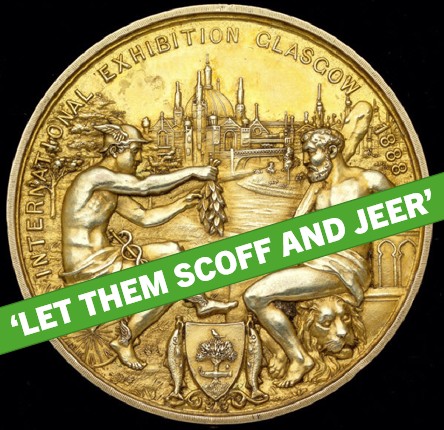
The reason the game was played there was because that year the Kelvingrove area was home to the city’s first ever major international event – the 1888 International Exhibition of Industry, Science and Art. And, of course, what major exhibition worth its salt didn’t have its own football tournament? Running between May and November, the International Exhibition showcased Glasgow as the Second City of Empire, highlighting Clydeside’s scientific and industrial achievements as well as the city’s burgeoning art scene.
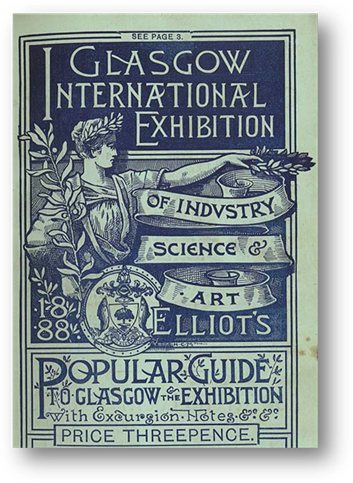
Massive temporary buildings were erected in Kelvingrove Park on then-fashionable oriental theme – the site was labelled ‘Baghdad by the Kelvin’ – to house thousands of different displays of engineering and technical equipment, textiles, shipbuilding, produce from around the world, musical instruments and art works. Other attractions including a ‘fairy fountain’, an early roller coaster and a reconstruction of one of Glasgow’s most famous medieval structures, the Bishop’s Castle, which had stood close to the Cathedral in the ancient heart of the city.
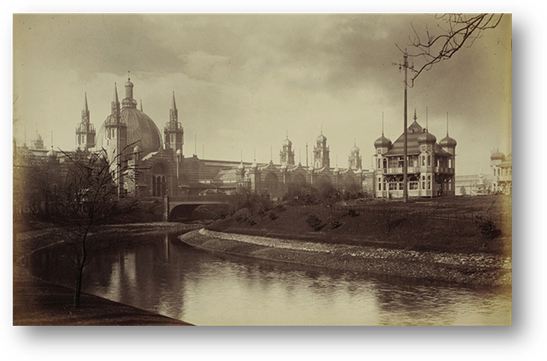
‘Baghdad by the Kelvin’ – the 1888 International Exhibition buildings
It was an incredible spectacle and the exhibition proved a huge success, attracting nearly six million visitors (Scotland’s population at the time was under four million) and boosting Glasgow’s reputation. It helped generate monies to enable the city fathers to build Kelvingrove Museum and Art Gallery on the site, undoubtedly one of Glasgow’s modern treasures. The event helped put Glasgow on the international map -with another exhibition following in 1901 on the same site and an even bigger event in 1938 at Bellahouston.
‘ANYTHING BUT GRATIFYING’
There were 16 teams who took part in Celtic’s maiden tournament, mostly Glasgow clubs but including sides from Lanarkshire, Ayrshire and Renfrewshire, many of whom are still in existence today. The winners of the final tie of the International Exhibition Cup to be held on 6th September 1888 would receive a handsome trophy, with the runners-ups being awarded gold badges.
Despite having played only four games, Celtic’s founding fathers were not overawed at the idea of taking on experienced competitors. They took confidence from the fact they had brought in leading players (with the exception of Willie Maley, Charlie Gorevin and a couple of others) from Hibernian, Renton and other established sides. Whether these players would ‘stick’ with Celtic would be determined by them taking the field for the club’s first Scottish Cup game on 1st September 1888 v Shettleston. Playing in the country’s national competition meant they were cup-tied, effectively binding them for the remainder of the season to that club. Celtic’s committee were fighting off attempts to persuade players such as nominal captain James Kelly to go elsewhere or head south across the border in return for ‘English gold.’ At this time there was no league competition in Scottish football and the season was made up of various cup competitions, local and national, and a large number of friendly games.
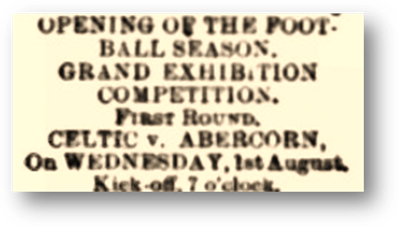
Celtic opened the tournament on 1.8.88 and their opponents were Abercorn, a Paisley team formed soon after local rivals St. Mirren in November 1877. An impressive crowd of 4,000 turned out for the evening fixture, double that of Celtic’s first game back in May, to watch two halves of 35 minutes duration. The first Celtic team to play in a competitive fixture was:
Dunning
Coleman (James) and McKeown
Gallagher, Kelly and McLaren
McCallum, Groves, Madden, Coleman (John) and Gorevin
According to the Scottish Umpire newspaper, it was a ‘stubbornly-fought and, at times, a rather heated, game.’ The North British Daily Mail, describing Celtic as ‘a club composed for the most part of players of the Catholic persuasion and hailing from the east end of the city’, said that play in the first half was even with Celtic scoring first and Abercorn ‘retaliating ere half-time.’ There were no further goals with the Evening Times reporting that the game ‘although evenly contested, was characterised by a good deal of wild kicking. In each team there was a lack of combination. The goalkeepers, however, deserve praise, as each guarded his citadel in a skilful manner.’
Abercorn had not been at full strength, according to the Scottish Umpire, which noted they ‘played up wonderfully and certainly had not the worst of it.’ The newspaper had a word of caution for Celtic club secretary, Willie Maley, who hadn’t played that day: ‘Gallacher, of the Celtic, must be looked after. He has a tendency to play reckless, and if his committee do not check it, he may yet bring discredit upon the whole team. See to it, Mr Maley.’
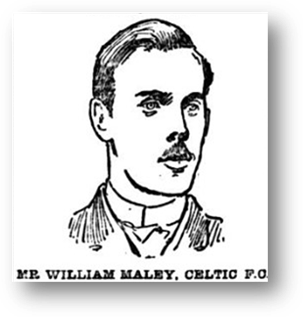
The Umpire also commented that ‘The Celtic could hardly be well pleased with their reception at the Exhibition on Wednesday. It was anything but gratifying towards the close of the game.’ Writing in his first published memoirs over 25 years later in 1915, Willie Maley recalled the experience under the heading ‘WHAT THE CELTIC HAD TO FIGHT AGAINST’: ‘Our rise in Scottish football was received by the public with anything but favour. In all the games played off Celtic Park up to this we had been received with scant courtesy, and had been howled at on more than one occasion as “professionals.”’ Referring specifically to the matches played during the Exhibition, Maley wrote: ‘During the course of these games the treatment given our team was a disgrace to the game as they were abused on all sides.’
‘THE ARCHBISHOP WILL BE THE REFEREE’
Despite having only recently formed, Celtic were already facing hostility from the Scottish footballing public. Initially, this appeared to because the new club were making mockery of the ‘shamateurism’ rampant in the Scottish game, where every club bar Queen’s Park made under-the-table payments to players whilst maintaining the pretence set by the SFA that the game was an amateur one. The wide-ranging practices had been fully exposed by Hibernian’s victory in the Scottish Cup final the year previous. Vale of Leven, who had lost the semi-final to Hibs, had protested on the basis of clear evidence from a private detective that certain Hibs players were being paid by the club. After the final had been played, an SFA committee hearing tied at six votes each on whether Hibs should be ejected from the competition, with the President’s casting vote going in Hibs’ favour – thus avoiding the need for the final to be replayed and the organisation’s reputation undermined further.
Celtic were prepared to push the SFA’s rules to their boundaries whilst leading the challenge for a league competition and professionalism to be introduced, which happened within a few short years. Celtic provided ‘clean’ accounts to the SFA when challenged which contained no evidence of any unlawful payments – signed off helpfully by Brother Dorotheus, Headmaster of St. Mary’s School in the Calton. Willie Maley later said of the taunt of professionalism against the new club: ‘Time has proved many things, and one is that the taunt might have been more widely distributed with truth. The conditions of the day in football was in our minds sufficient excuse for rule breaking.’
There was clearly something else at play beyond disdain for professionalism. Many newspapers made frequent reference to the club’s open identity as Irish and Catholic – a status clearly asserted in the circular of January 1888 sent around the city’s east end parishes – but some went much further. One of the club’s earliest detractors was a sports columnist who went under the name ‘Viator’ in the Glasgow Evening News. He had taken a few pot shots at the club’s professional approach without anyone at Celtic rising to his bait and then, following the Abercorn match, he saw fit to mock Celtic in his column with a spoof story:
A novel football match, I am informed, will take place in the Celtic Football ground early in September when eleven priests of Irish extraction will play a match with an eleven of their Scottish brethren. The Archbishop will be referee. Father McGinnis keeps goal for the Irish and likely Monsignor Munro will do the same for the Scotch. The gate goes to the poor.’
The Celtic committee again refused to respond to the taunting, biding their time instead.

Having drawn the game with Abercorn, Celtic were waiting for a date for a replay to be confirmed. Instead, the Paisley team withdrew from the competition for reasons unknown, which meant Celtic went into the hat for the second-round draw. Dumbarton Athletic were associated with the Denny shipbuilding yard on the River Leven in the town and would ultimately merge with Dumbarton FC in 1889. The Celtic full-back James Coleman had previously played for the Athletics although their most famous player would prove to be Alex Latta, a forward, who was capped twice for Scotland and spent six successful seasons with Everton.
They had beaten Greenock Morton 2-1 in the first round of the Exhibition tourney and their game against Celtic would provide a historic footnote to the club’s short-lived existence. The Tuesday night encounter saw goalkeeper John Tobin make his debut for Celtic who got off to a whirlwind start, scoring three goals within ten minutes. The Athletics could only counter with a single goal which meant Celtic’s first ever competitive victory had a 3-1 scoreline. The goalscorers were not identified in any of the brief match reports.
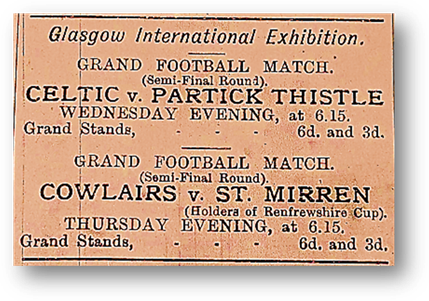
Celtic’s reward was a semi-final clash against Partick Thistle, conquerors of Airdrieonians and Kilbirnie, while St Mirren had drawn Cowlairs from Glasgow’s northern district in the other semi. The Jags had been founded 12 years earlier and their home was at Inchview Park in Whiteinch, close to the northern entrance of the Clyde Tunnel today. It would be 1908 before the club left Clydeside for their permanent home in Maryhill at Firhill Park.
Celtic’s first competitive Glasgow derby was a close encounter. The Glasgow Herald reported that ‘a large turnout of spectators’ watched on as there was little to divide the two sides. The game remained deadlocked into the second half and then, with twenty minutes left, the Jags left-winger Ferguson, twisted his leg badly and had to leave the field. As no substitutes were allowed at this time, Celtic had a man advantage and ‘near the end of the game, the “Celts” by a determined effort, scored. Nothing else was done.’ The game had ended 1-0 – with Celtic progressing to the final, where Cowlairs would await.
‘THE MOTLEY CROWD’
It was an impressive achievement to reach a final at the first time of asking. The men who had formed Celtic in the preceding months led by Brother Walfrid would undoubtedly be happy with the early progress made yet mindful that, once again, certain newspapers were fixating on the club’s identity. The North British Daily Mail reported that a group of French visitors had taken in the Celtic – Partick Thistle semi-final: ‘They had never seen such a game before, but when it was explained to them they understood and enjoyed it. They preferred to call the Partick men the Scotchmen, and their opponents the Irishmen – an accurate enough description.’
Three days after the Thistle game, the Glasgow Evening Post published a letter which was an all-out assault on Celtic FC, the community it came from and how it went about its business. An agenda was clearly being developed with the encouragement of the city’s sporting media. The letter started:
In the first place, the principle of organising a club of which the membership shall be confined to Roman Catholics is one not agreeable to common-sense or religious tolerance. If the object were to elevate football and its associations by wedding it to religion we should be silent, but no one can pretend that this will be the effect that will flow from the motley crowd that compose the Celtic team.
The new Glasgow club, while announcing that its primary purpose was to raise funds in support of the Poor Children’s Dinner Tables run by the Marist Brothers at the three Catholic schools in the east of the city, had never declared that its membership was restricted to Catholics – nor was that ever to be the case. Yet, it had been clear for many years that some Scottish and Glasgow clubs did operate a sectarian bar regarding Catholic players which, interestingly, this individual did not see fit to comment upon. Hibernian FC had come into being in 1875 because the club’s founders were not allowed to join in games on Edinburgh’s Meadows on account of their Irish accents. Other clubs had arisen from the auspices of Protestant churches and organisations. Of course, the charitable objectives of the new Celtic club were equally of no interest to the anonymous letter-writer.
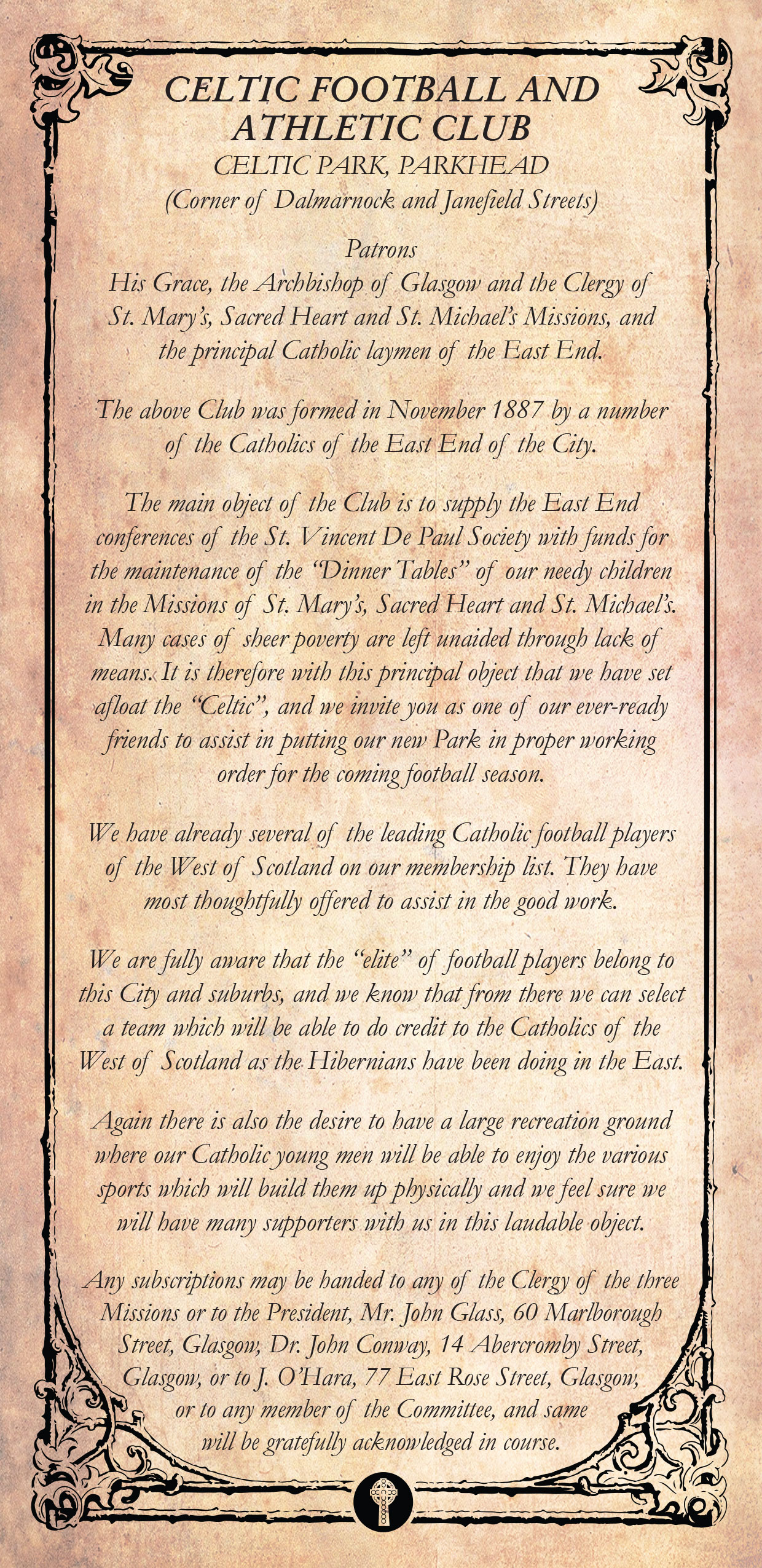
A reproduction of the Celtic Circular, the club’s mission statement issued in January 1888
The main target of the letter which the Glasgow Evening Post saw fit to publish, inspired by various comments from its columnist Viator who the letter-writer applauded, was that Celtic had gathered in prominent players from around the country ‘by the most barefaced and detestable tactics yet practiced by a Scotch club’:
Was it their Irish patriotism that induced Kelly and M’Callum to desert the strongest football combination of modern times, the present champions of the world? … How is it that that by his daily work a player in Dunbartonshire makes, say, fifteen shillings a week and on being taken under the patronage of a club such as the Celtic makes double that amount? If that workman had not been a clever player would he have got the same wages? Certainly not; and is, say, his employer so zealous for the success of Catholic football as to be fifteen shillings per week out of pocket for the sake of retaining the services of this able player? I don’t think so. The whole business is a disgrace to Scotch football … The sooner our football legislators deal with such clubs as the Celtic, and that sharply, the sooner will Scottish football be cleared of the mists of corruption that at present envelope it.
The ‘mists of corruption’ language has a familiar, modern ring to it. It is the kind of language used by those accustomed to privilege and for whom equality feels like oppression – and nothing oppresses them more than a successful Celtic side.
The intemperate language of this 1888 letter – and the decision to publish it – was designed to rouse ill-feeling towards Celtic as an undeniably Catholic and Irish club attempting to make its way in Scottish football. The new club had no truck with the ‘shamateurism’ which was clearly hiding in plain sight throughout the game, instead openly advocating an honest approach to professionalism. Yet rather than attack the hypocrites at the SFA and those maintaining the amateur myth, certain Scottish newspapers who were well aware of the facts chose to target Celtic instead, persistently highlighting the club’s Catholic and Irish affiliations along the way.
This was not coincidental.
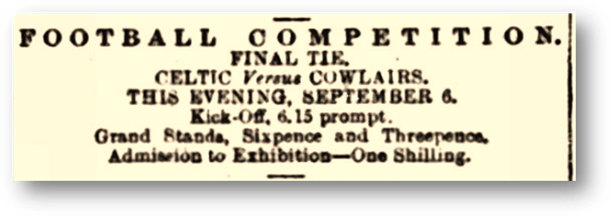
There was some press criticism of the competition organisers’ refusal to reduce admission prices by half for the final to sixpence and ensure that ‘the fare offered is not above the class which it concerns.’ Regardless, an ‘immense crowd’ of 6,000 was attracted to the Varsity recreation ground to watch Celtic take on Cowlairs, who had also won their semi-final 1-0.
When the team-sheets were made available, the Celtic committee immediately raised a protest. As the Scottish Umpire reported, Cowlairs had ‘strengthened their ranks by the inclusion of Allan Stewart (Queen’s Park) at half-back and J. McCall (Renton), forward.’ The newspaper pointedly stated that ‘The Celts relied upon their own men.’ This was what angered Celtic: Stewart and McCall were both internationalists and registered with clubs other than Cowlairs however, as neither of those teams was playing in this tournament, they were allowed to take the field against Celtic. The irony was that McCall particularly – for whom Celtic played a benefit match in 1890 and were censured by the SFA – would have received a financial inducement to turn out for Cowlairs yet received no criticism from Celtic’s tormentors in the press.
Celtic won the toss and chose to play with the advantage of the slight wind behind them in the first half and ‘early made themselves dangerous’ according to the Scottish Leader: ‘Both sides showed great dash. The Celts had most of the game but their efforts to score were somewhat weak. The Cowlairs broke away repeatedly, but M’Keown defended cleverly. The game continued mostly in favour of the Celts til nearly half-time, when Sinclair and M’Call on two occasions almost got a point.’ The Evening Times reported that the crowd favoured one team over the other: ‘There was no mistake as to which side the majority looking on leaned. The Celtic were not the favourites.’
The score was 0-0 when the sides changed ends. With the wind at their backs, Cowlairs were on the front foot early in the second half. Five minutes had elapsed when Celtic’s ‘Auld Gineral’ James McLaren was penalised for a challenge which the Scottish Umpire labelled a ‘perfectly legitimate charge.’ From the free kick, the Queen’s Park player Stewart scored to put Cowlairs ahead. The game swung between the two sides with Cowlairs claiming for a goal with a shot that struck a post and Celtic forcing ‘keeper Tom Duff into action ‘which he cleverly did.’ Fifteen minutes into the second half, Cowlairs scored again through Bishop – there would be no way back for Celtic. The final was lost 2-0. According to the match reports, the best for Cowlairs had been McGiness and McCall and the most impressive Celts on show were McCallum and McKeown.
‘LET THEM SCOFF AND JEER’
The Evening Times noted that Cowlairs’ victory had proven popular with the crowd yet ‘the play was, however, not so unequal as the score and the Celtic deserved a better appreciation than they received.’ The Scottish Umpire struck a similar sentiment stating that Celtic ‘ultimately retired beaten after a very equal game by 2 goals to nil. The spectators all through showed a not always intelligent preference for the winners, and the victory was therefore a popular one.’ Willie Maley recalled in 1915 that Celtic had been ‘beaten by a team made up of Cowlairs, Queen’s Park, Renton, etc’ and that throughout the final ‘our lot were jeered at and insulted in disgraceful fashion.’ The press campaign had clearly worked: the majority of the Glasgow crowd were willing Celtic to fail, even while recognising that Cowlairs had undermined the spirit of the game by fielding players from rival clubs.
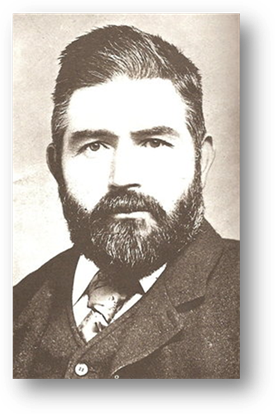
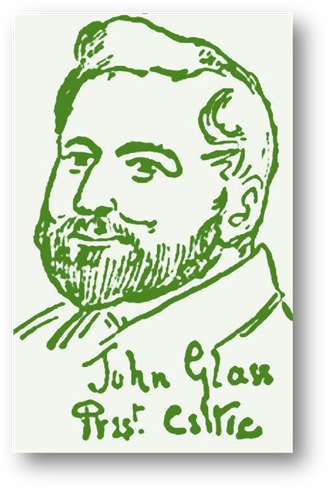
John Glass, founding father and President of Celtic
The ill-treatment towards the Celtic players and party continued afterwards and was never forgotten. Writing in the Celtic Football Guide of 1937/8, then-manager Willie Maley recalled the post-match dinner where Cowlairs received the Exhibition trophy and Celtic the loser’s medals: ‘an ill-mannered lot of listeners could not restrain their glee at the Celtic downfall and voiced them in no uncertain voice.’
The Celtic President, John Glass, rose to speak, returning his thanks for the vote of sympathy shown by Cowlairs, and then took aim at what Maley described as ‘the bunch of biased interrupters’ at the dinner as well as the unsportsmanlike reception that Celtic had received from spectators, including spitting, at the game itself:
Let them scoff and jeer. Celtic will yet win to our proper position by our merits and those who scoff today will one day have to applaud.
john glass
Those were the words recorded by Celtic Chairman Tom White in 1923 in his ‘History of Celtic F.C’ in the Glasgow Eastern Standard newspaper. It was White who received all of John Glass’ shares in Celtic when the Celtic President died in 1906, going on to establish the White-Kelly dynasty at the club that endured through to the 1990s.
Willie Maley records a similar sentiment in his record of John Glass’ statement that night however his recall of the President’s wording differed: ‘Celtic would weather this defeat like all good sportsmen, and I prophesy that those who come here today to jeer, will by the powers of the Celtic, come in time to cheer.’
The treatment meted out to the Celtic players throughout the Exhibition tournament and the adverse press coverage that the club – referred to in the Dundee Courier the day after the final as the ‘Glasgow-Irish Roman Catholic combination’ – was subjected to sparked a reaction in the hearts of Celtic’s founding fathers, as Maley confirmed: ‘Our management received then the real stimulus to make the club, which was then so unjustly derided, a power in the land.’
Celtic would continue to have detractors in the media for many years to come. In 1906, Willie Maley issued a letter criticising ‘the bigotry and anti-Celtic feelings of the alleged fair-minded athletic Press of Glasgow’: ‘Since this club was formed the aforesaid scribes have at all times taken every little chance they could to belittle the club and its followers, and to gloat over its defeats . . . The opinion of the critics previously referred to of course does not worry the club in the least. We have lived against it (and I think done fairly well) for 18 years, and feel quite easy in mind as to their ability to harm us or even worry us.’
‘Sweet revenge’ was quickly taken on Cowlairs in the second round of the Scottish Cup the following month when they were subjected to an 8-0 drubbing at Celtic Park, with Mick Dunbar scoring Celtic’s first-ever competitive hat-trick. Celtic progressed all the way to the final of the Scottish Cup at the first attempt that season, losing out to Third Lanark in a replay in February 1889. There was consolation though, three months later, when Celtic won the last competition they’d entered in season 1888-9. The club’s first-ever trophy, the North-Eastern Cup, was won at Clyde’s ground on 11th May 1889 in a 6-1 defeat over . . . Cowlairs.
The jeers had turned to cheers and Celtic would, in due course, go on to become the biggest and most successful club in Scottish football history.
The prophecy of John Glass has been fulfilled.
Read more Celtic history articles from The Shamrock here: https://the-shamrock.net/the-shamrock-online/
By Issues 1-10 of The Shamrock fanzine here: https://the-shamrock.net/magazine/


Football is an extension of Scottish culture. It mirrors the attitudes of the national populace. In 1560 that culture became decidedly Protestant and those attitudes became part of the national DNA. Witness the world’s oldest known club: the John Hope Foot-Ball club of Edinburgh f. 1824. Hope used his games, to lecture the players on the twin evils of Alcohol and Popery. Recall Hibernian being refused admission to the SFA in 1875 because it was only for ‘Scotch clubs’.
It is to the credit of Celtic’s founders that they stuck in and made the club a unique success. After all, the first ‘Celtic’ club had briefly played in 1873. It took 14 more years before a club for the poor Irish could survive: in part because there were then enough Irish in Glasgow to turn Celtic into an unstoppable force.