
We have applied to the Legislature, in vain, for a remedy against the annual inundation of pauper Irish with which we are afflicted. They are landed by thousands, we may say, since the Irish famine by tens of thousands . . . We have thus to bear the expense of supporting the lives of perhaps the most improvident, intemperate and unreasonable beings that exist on the face of the earth, who infest us in shoals and beg our charity because the land of their birth either cannot or will not support them. Our hospitals are filled with them, our police are overwrought by them, our people are robbed and murdered by them. Glasgow Herald, 1st April 1850
By 1850, the unfolding famine in Ireland that would become known as The Great Hunger (An Gorta Mór in Irish) was in its fifth year and the worst effects were now being felt. From the hundreds of thousands who fled Ireland to avoid starvation, many headed for Glasgow. It was an embarkation point for those who could afford the cost of the sail to a new life in North America or Australia. Many were passing through Clydeside to neighbouring areas such as Lanarkshire, Renfrewshire or Ayrshire where there was the hope of work. For many more Irish though – men, women and children – Glasgow would be their new home.
The Glasgow Herald’s callous and false portrayal of the Irish newcomers as beggars, thieves and even killers who were inundating the city and overwhelming it contains many of the racist stereotypes still used in Britain’s media and by politicians and racist agitators today to attack and stigmatise immigrants and refugees. Contempt rather than compassion was what the Irish faced on arrival at Glasgow’s Broomielaw Quay and when settling around the city – despite the fact that the majority were starving and dangerously ill.
‘STARVING IN THE MIDST OF PLENTY’
Historian Tom Devine refers to The Great Hunger as “the greatest human disaster in 19th century Europe” with one-eighth of the entire population of Ireland dying due to starvation or disease, amounting to over one million people. Devine says it was more lethal than the majority of famines in modern times. By comparison, the number of deaths during the Ethiopian famine of 1983-5 is estimated anywhere between 300,000 to 1 million from a population of 37 million. In the ten-year period between 1845 and 1855, it is now understood almost two million Irish fled the island for overseas. From a population of 8.1 million in 1840, there were only 5.4 million people living in Ireland in 1871. By 2022 the population of the Republic of Ireland stood at 7.1 million – the only country in the world with a population smaller than it had been in the 19th century.
“Infesting us in shoals” the Glasgow Herald had written in stark, racist language “because the land of their birth either cannot or will not support them.” Yet the Irish were not immigrants in the common sense of the word. Like the Scots, they were bound – although not voluntarily – with the English (and Welsh) in a political and economic union. According to Dr. John McCaffrey of Glasgow University: “Since the Irish Act of Union in 1801, constitutionally as well as economically this represented just another movement of labour adjusting from the narrowing opportunities in one part of that United Kingdom to areas of growing labour demand in another.”
England had controlled Ireland since the early 1600s and had engaged in various ‘plantations’ of English and then Scottish Protestants throughout the island but especially in the north. In1800 the Parliament of Ireland was abolished – British politicians and civil servants effectively governed Ireland from that point onwards.
The Irish people were not in control of their destiny when the first potato crop failed in 1845. The cause was a fungus known as potato blight or rot which ravaged potato plants, rendering them inedible. The fungus was first identified in the USA in 1843 and then unwittingly exported to Belgium. Large agricultural areas of western Europe were then affected. Around 100,000 people died in Belgium, Prussia and France. The blight also affected the potato crop in the Scottish Highland and almost 200,000 people were at serious risk. Unlike in Ireland, a major mortality crisis was averted in Scotland because of what Tom Devine describes as an “extensive relief effort organised by some landowners, the Free Church of Scotland and Lowland charities.” While the Highlanders escaped mass starvation, up to a third of the entire population of the western mainland and the Hebrides left Scotland permanently in the aftermath of the potato blight, with many receiving financial ‘assistance’ from landlords to leave their homes.
In Ireland, there was to be no relief effort of the necessary scale required to avoid massive loss of life as had been put in place in Scotland and in other countries such as Belgium, which was more densely populated than Ireland. The British Government was aware of the unfolding disaster long before the first deaths from hunger occurred in Ireland in early 1846. They introduced soup kitchens in January 1847 which were soon being used by more than three million per day – then withdrew them six months later, in what would prove to be the most disastrous period of the seven-year famine.
The British administration’s view of the crisis was shaped by two key principles: that it was not the role of government to interfere in the workings of the free market which would operate naturally to avert social disaster; and the theory put forward by Thomas Malthus that famine and disease were natural controls to correct over-population in society. British views of the Irish were also of vital importance in deciding how the crisis would be managed. Sir Charles Trevelyan, a student of Malthus who is referred to in the ballad The Fields of Athenry, was the senior civil servant at the Treasury in charge of the relief effort in both Ireland and Scotland. He referred to the widespread starvation arriving from the failure of the Irish potato crop as “the judgement of God on an indolent and unself-reliant people.” He went further in the book he found time to write while human calamity unfolded in 1848 called The Irish Crisis:
The judgement of God sent the calamity to teach the Irish a lesson, that calamity must not be too much mitigated. … The real evil with which we have to contend is not the physical evil of the Famine, but the moral evil of the selfish, perverse and turbulent character of the people.

The Irish were left to fend for themselves as starvation and disease took hold on the island. Yet, controversy remains over whether what happened in Ireland at this time can appropriately be referred to as a famine. The standard dictionary definition of the term is a situation where there is an extreme scarcity of food for a group of people causing illness and death. Incontrovertibly, in Ireland in the 1840s there was an abundance of food. This is known because shipping records confirm it was being exported at the time in great amounts from Ireland to England.
Dr James Handley, the acclaimed expert on the Irish in Scotland and the first biographer of Celtic Football Club, wrote that in the last four months of 1845 more than 3,250,000 quarters of grain were exported across the Irish Sea. Research by historian Christine Kinealy discovered that in 1846 alone 186,000 oxen, 259,000 sheep and 480,000 pigs were shipped to Britain. By 1850, 90 million eggs were being imported into Liverpool annually. In 1846 and 1847, she found that 430,000 tonnes of grain had left Ireland for Britain – enough to feed up to two million people for 16 months. Kinealy concluded: “In short, human life was sacrificed to ideology and, more importantly, high profits.”
It is on this basis that Handley argued that the Irish were “starving in the midst of plenty.” Ireland was known at the time as ‘the granary of Britain’ and the British Government would not allow even the real risk of death to hundreds of thousands of Irish people to interfere with imperial commerce and its food supplies. There can be no famine in circumstances where there is plenty of food, it is argued. Some now go further and contend that the British Government’s refusal to act in the face of a mounting nationwide calamity that would ultimately cost a million Irish lives amounted to a genocide.
Writing in 1860, Irish nationalist John Mitchel set out the case labelling what occurred in Ireland an ‘artificial famine’ and laid the blame for the deaths of over a million Irish squarely at the door of the British Government:
I have called it an artificial famine: that is to say, it was a famine which desolated a rich and fertile island that produced every year abundance and superabundance to sustain all her people and many more. The English, indeed, call the famine a “dispensation of Providence”; and ascribe it entirely to the blight on potatoes. But potatoes failed in like manner all over Europe; yet there was no famine save in Ireland. The British account of the matter, then, is first, a fraud; second, a blasphemy. The Almighty, indeed, sent the potato blight, but the English created the famine.
‘DEAR GREEN PLACE’ TO ‘SECOND CITY OF THE EMPIRE’
Historians now estimate that 2.1 million people emigrated from Ireland during the famine years with over a quarter of a million moving to Britain. While fewer than 100,000 Irish settled in Scotland in these years of crisis, Tom Devine notes that “In relative terms, however, this was an enormous and unique burden for a small country which contained only around 2.8 million inhabitants in 1845.”
The ports of Liverpool and Glasgow were the principal destinations of those who left for Britain. The attraction of Merseyside and Clydeside was that they were the closest and cheapest means of escape for the poorest people on the island seeking salvation. Glasgow made sense for those based in the north of Ireland as many Irish from those counties had been annual visitors to Scotland for the seasonal harvest for many years, landing in Glasgow.
St. Mungo (Kentigern) first built a church next to the Molendinar Burn before it runs downhill into the River Clyde around the 6th Century AD. The area was known by its Gaelic name of Glaschu, translated as dear green place or valley. The church was replaced by a cathedral in 1136 and in the medieval era Glasgow was one of Scotland’s largest towns with a population of around 1,500. University status was granted in 1451 and Glasgow went through spurts of development. Home to over 7,000 people and various small industries by 1700, the building of the first quay at Broomielaw in 1601 led to the development of Glasgow as one of the great city ports of the world and the focal point of Britain’s tobacco trade with North America and the West Indies. Shipbuilding and other trades and industries soon made their mark on the developing city by the Clyde.
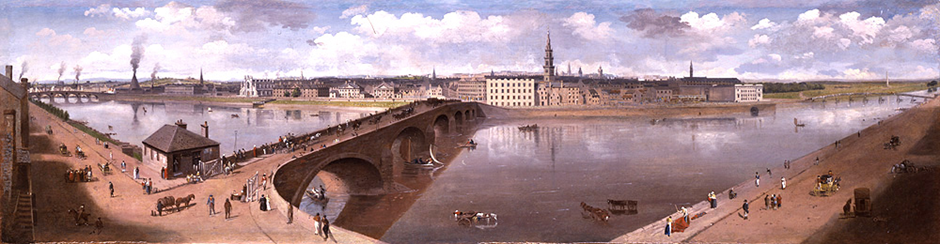
Many of those who had previously settled in Glasgow and Scotland in the early 1800s were Ulster Protestants although marked in official documents as ‘Irish born’. It was they who gave towns such as Airdrie, Larkhall and Motherwell and Glasgow districts such as Govan, Bridgeton and Partick strong Protestant identities, establishing Orange Order lodges in their new homes. In contrast, the Irish who arrived during and in the aftermath of the famine years were largely Catholic, as Devine identified: “The famine migrations therefore seem to have been mainly Catholic with south Ulster, parts of Donegal, Cavan, Monaghan and Sligo well-represented.” The religious identity of the new Irish immigrants would ultimately give rise to what commentator Colm Brogan referred to in The Glasgow Story (1952) as “Glasgow’s favourite problem” creating a social mix of Catholic and Protestant, Irish and native Scot, that has indelibly marked and shaped the city’s identity ever since.
Yet Irish Catholics formed a considerable minority of the population of Glasgow in the decades prior to the years of famine. It had not always been that way: in the aftermath of the Scottish Reformation and the execution by hanging of Jesuit priest John Ogilvie at Glasgow Cross in 1615, Catholicism had largely been extinguished in the city, at least openly. Brogan’s book makes reference to an oft-repeated claim that towards the end of the 1700s the Catholic population of Glasgow amounted to thirty-nine while the town was home to forty-three anti-Catholic societies, prompting Brogan’s comment: “So it might be said that the Catholics were receiving individual attention though not of a benevolent kind.”
The actual source of the statistic is a Glasgow merchant called Robert Reid who died in 1864 at the age of 91 and had become known in his later years for writing historical articles about the city which he had witnessed develop from a small settlement on the banks of the Clyde. Using the pen name ‘Senex’ his regular articles in the Glasgow Herald were published collectively in 1851 in a book called Glasgow Past and Present. In a chapter on the Popery Riots that took place in Glasgow in 1778, Reid wrote: “It is curious to think that, amidst all the violence of feeling against Papists which at this time pervaded nearly every rank of our citizens, there were not then in Glasgow more than about a score of persons who professed the Roman Catholic religion, and these were merely a parcel of poor Highlanders with their wives and children who met in a quiet and inoffensive manner in a small back room in the High Steet.”
In 1778, the Westminster Government had passed The Papists Act which was designed to loosen the most severe anti-Catholic legislation in place in England and Wales. There was speculation that the Act would be extended to Scotland which resulted in vigorous campaigning by bodies such as the Protestant Association, led by Lord George Gordon. On 13th October 1778 the Glasgow Synod of the Church of Scotland passed various resolutions opposing the repeal of anti-Catholic laws and, five days later, a riot broke out on the High Street in Glasgow.
A mob gathered outside the house of Donald McDonald, a Highlander, near the College Kirk where they believed a small group of Catholics were worshipping, as Reid recalled:
The mob not only insulted but terrified the poor people to the highest degree. The only person like a gentleman amongst the Papists escaped in a chair, amidst the curses and imprecations of the multitude. Some poor Highland women had their caps and cloaks torn off them, and were pelted with dirt and stones. In short, the rabble continued their outrages til night, when they broke all the windows of the house, breathing blood and slaughter to all Papists.
McDonald’s house had been looted and destroyed. It was no longer safe for Catholics to meet in public and so they began attending Mass secretly in the home of Robert Bagnall, an English potter who lived on the Gallowgate. On 9th February 1779 another mob attacked and set fire to Bagnall’s home before attacking his shop on King Street and destroying all its contents before the military arrived. Although some of the rioters were captured and jailed, “to prevent worse consequences they were released.” The Bagnall family moved to the relative safety of East Lothian in 1780 and one of the sons was ordained a Catholic priest in 1795.
The anti-Catholic violence witnessed in Glasgow (and personally by Robert Reid) was not repeated on the same scale in the city but when Gordon led a Protestant Association march on Westminster in May 1780, it sparked a week-long orgy of violence in London. Known as the Gordon Riots, demonstrators looted and burned Catholic churches and foreign embassies in the capital, rampaged through the area of Moorfields which was known to house hundreds of Irish Catholic immigrants and also attacked prisons as well as the Bank of England. The army had to be called out to restore order with 285 rioters being shot dead and 200 more wounded. These anti-Catholic disturbances remain the most destructive urban riots in English history to this day.
By 1782, small numbers of Catholics in Glasgow were again attending Mass openly in the city, sometimes celebrated by Bishop George Hay (secretly consecrated in 1769) in a small room at the foot of the Saltmarket, opposite the Bridgegate. For a few years after they met “under authority” to worship in the Town’s Court, Mitchell Street, where numbers had been swelled to over 200 by the arrival of Highlanders who settled in the Glengarry area of Bridgeton and their safety to congregate for Catholic worship was guaranteed by their wealthy employers. (Read the earlier article ‘Glengarry – the Sacred Heart of Glasgow’ here: https://the-shamrock.net/2016/09/18/glengarry/).
A priest, Father Andrew Scott, was appointed to what was now referred to as St. Andrew’s Parish in 1792 and by 1795 the numbers of Catholics resident in Glasgow had risen sufficiently, and anti-Catholic sentiment had also subsided, for the first purpose-built Roman Catholic church and school to be erected in the city since the Reformation.
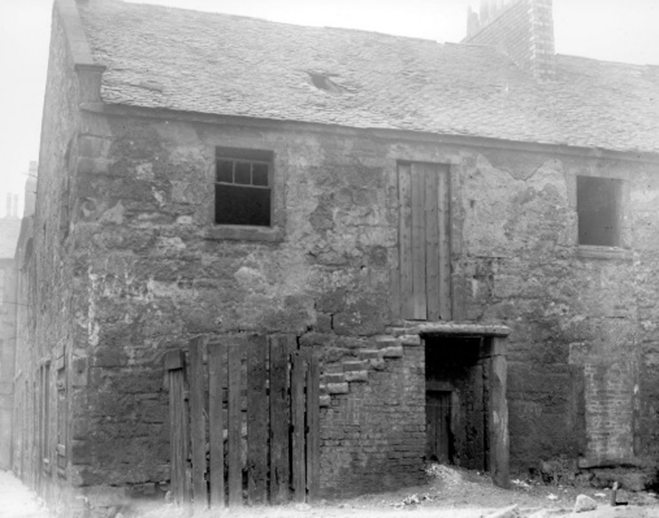
Pictured here in 1893, this former Catholic School Society building was located on Marshall Lane (or Street) in the Calton, just a few yards west of the site of Hielan Jessie’s pub on the Gallowgate today. It was here that Glasgow’s Catholics attended Mass for nearly 20 years, building up a congregation from 600 to 3,000 communicants by 1814, leading to the decision to build St Andrew’s Church by the river on Clyde Street in 1814. Work on building the new church was delayed by night-time anti-Catholic saboteurs but, with the financial support of Protestant churches in the city, the building was finally completed. Mass was said for the first time in December 1816 and in 1814 it became St. Andrews Cathedral and still stands on Clyde Street today.
‘THE SHOCK TROOPS OF THE INDUSTRIAL OFFENSIVE’
The principal reason for the visibly large increase in Catholics living in Glasgow in the early 1800s was the settlement Irishmen and women in the city in great numbers. The first steamboat from Glasgow to Belfast sailed in 1818 and as early as 1833 one Glasgow newspaper, the Glasgow Argus, wrote that the steamer Antelope arrived at Broomielaw with “upwards of a thousand of the most wretched of misgoverned Ireland’s poor upon her decks.”
In the summer of 1842, the Glasgow Courier recorded the arrival of 1,200 Irish reapers on the SS Aurora from Belfast in time for the summer harvest: “When the Aurora arrived in Glasgow it was crowded in every part. The whole length and breadth of the steerage presented a mass of human beings literally packed together and not a few of them had taken position on the quarter deck, in fact the appearance of that vessel was that of a shipload of heads and faces.”
Within a few years the ‘ships of heads and faces’ would be a much more frequent sight as they made their way up the Clyde in far more desperate circumstances.

By 1841, it was estimated that 43,000 Catholics now resided in Glasgow, overwhelmingly Irish although the church hierarchy and many of the priests were Scottish Highlanders. The following year St. Mary’s Church of the Assumption opened in the Calton district, only the city’s second Catholic church post-Reformation. The Abercromby Street building was the second largest church in all of Scotland sitting 1,500 people and designed to meet the needs of a huge congregation.
The main reason why so many Irish had moved to Glasgow in the early 1800s was because of the large number of jobs available in the city and surrounds. Glasgow’s population at this time was 274,533, a massive increase from the 77,385 resident just forty years earlier. There was concern that the 1841 census, taking place in June during holidays, would lead to a lower head count so the city fathers held a second census to ensure that Glasgow, through population, would continue to beat Birmingham to the much-envied title of ‘Second City of the Empire.’
Glasgow was a boom town and its successful development, based initially on a burgeoning cotton industry, was fuelled by the creation of a huge port right in the centre of the city with transatlantic connections as well as ship-building, engineering, coal-mining and a growing iron trade. The city grew and grew, swallowing up the surrounding districts – initially Calton, Bridgeton and Gorbals then Hillhead and Pollokshields – before the burghs of Partick, Govan and Pollokshaws fell within the city boundaries in 1912 and Glasgow’s population exceeded the incredible figure of one million.
This massive industrial growth required bodies and it was Irish navigators (‘navvies’) who were in the vanguard in Scotland in building the canals, railways, factories and massive power and water facilities. They had characteristics which made them well-suited to Glasgow’s needs, as Colm Brogan outlined: “The immigrants had certain qualities which were invaluable for a rapidly expanding city. Their physical strength and hardihood and energy were beyond question. They were ready to bear with primitive conditions of work and living, to toil heavily and to take considerable risks if they had the chance of sending a few shillings home to their parents or dependants . . . The Irish labourers would tackle anything. They set an example of daring in descending the deep new pits, and they showed a cheerful disregard of the dangers of dynamite. They were the shock troops of the industrial offensive.”
In 1841 the Irish Catholic community in Glasgow of 43,000 accounted for roughly one-sixth of the city’s inhabitants (in Scotland that year the census recorded that 126,321 people were Irish-born). The first Catholic churches since St Andrew’s were being built in the centre and outlying districts, work was plentiful, social conflict was negligible and prospects for further development were encouraging.
No-one at that time predicted the “human catastrophe of great magnitude” (Devine) which was about to strike Ireland – and alter the course of Glasgow history forever.
THE CONDITION OF IRELAND – 1849
‘Those who starvation spares, disease cuts off’
What was life like in Ireland in the midst of the unfolding disaster that forced so many people to seek shelter away from their homeland and caused the untimlely deaths of hundreds of thousands of others?
The hellish circumstances of the Irish and the rising death toll were widely known in Britain due to extensive coverage in the newspapers of the day. The best-selling English newspaper, The Times, published a letter from Cork magistrate Nicholas Cummins in December 1846 describing horrific scenes in and around Skibereen. He intitially thought the hamlet was empty before discovering people huddled together in hovels who were not dead, as first thought, but fever-stricken. That morning police had discovered two corpses nearby which had been half-devoured by rats. Cummins witnessed a frail mother barely able to drag the corpse of her 12 year old daughter out into the open, half covering the child’s body with stones. A local doctor found seven bodies under a cloak: one was dead but the other half dozen were so ill they could neither move the corpse or themselves.
Throughout the years of crisis, The Times in London reported daily on events in Ireland but in a way designed to normalise the worst famine in living memory, while arguing that the Irish were undeserving of more support and that the Government should maintain a minimalist response to providing relief. In contrast, other newspapers and magazines tried to persuade the Government that the dire situation required an emergency response and more dedicated financial resources to save the lives of hundreds of thousands of people who were, technically, citizens of the United Kingdom.
Before Christmas 1849, the Illustrated London News published a series of articles by artist and writer James Mahony. Originally from Cork, in late 1849 Mahony travelled through County Clare and County Galway in the south-west of Ireland. In his words and images, he recorded how the people were still being ravaged as An Gorta Mór persisted due in large part to little or no relief effort – and revealed that a significant immoral land grab was underway at the same time. Introducing the series, Mahony wrote: “The present fearful Condition of Ireland, made considerably worse, we believe, by the operation of the New Poor-Law, has induced us to give, as far as posssible, a faithful report of the working of this Law.”
Two years earlier the ILN had published Mahony’s shocking eye-witness account of what was happening to the people who lived in and around Skibbereen in West Cork. As a result of his work in documenting how hundreds of thousands of his countrymen and women came to perish, Mahony is featured in the book Heroes of Ireland’s Great Hunger where Niamh Ann Kelly says of him: “It is with lasting effect that, in his recounting of an imperially conditioned horror of modern life – famine – he did not look away.”
Starting his journey in the coastal town of Kilrush in County Clare, close to the modern shrine at Knock, Mahony reported that the settlement had all the advantages of a great trading and fishing port yet was going rapidly to decay. In the district, it was estimated that up to 35% of the local population of 82,000 had required to apply for relief while the local workhouse contained over 2,500 paupers. Alarmingly, he came across large numbers of people living in scalps – holes dug into the earth a couple of feet deep.
One such person was Brian Connor who had been living in a space in the ground with his family of three for a number of months. Mahony described the space as “roofed over witih sticks and pieces of turf, laid in the shape of an inverted saucer. It resembles, though not quite so large, one of the ant-hills of the African forests.”

The Connors, like many of their neighbours, had been made homeless by their landlords after failing to maintain rent payments. Their homes were either demolished or the roofs were removed to make them uninhabitable. The local Poor Law inspector, Captain Kennedy, told the journalist: “None of the houseless class can now find admittances save into some over-crowded cabin, whose inmates seldom survive a month.” The Connors were fearful of being forced out of their hole in the ground by the landowner’s henchmen: “Brian Connor dreads nothing so much as that he shall not be allowed, now that his hut has been discovered, to burrow longer in security; and like a fox, or some other vermin, he expects to be unearthed, and left even without the shelter of what may be called a preparatory grave.”
The article highlighted the injustice of a Poor Law system introduced to be the means of the salavation of the people but instead became the instrument of their destruction – by requiring them to surrender any property that they owned before they would be entitled to state relief. The failure of the potato crop year after year created the opportunity for more land to be taken over by the large estates owned by absentee landlords, resident in England, and for soil cultivation to be changed from potatoes to corn to increase estate profits. “Their greatest ambition, apparently, is to get rid of the people.”
A common sight was villages, such as Tullig which lay a mile from the Atlantic Coast, which weren’t deserted as much as destroyed: “The ruthless spoiler has been at work and swept away the shelter that honest industry had prepared for suffering and toiling humanity. A conqueror would not have had time and security to do the mischief which is perpetrated in safety under the guaridanship of the laws by the Irish themselves.” People never returned to live in Tullig, drawn below, which remains an abandoned village to this day.

For those denied access to relief or the local poor house, the search for food was their only occupation. Mahony struggled to understand the hopeless foraging he saw taking place in fields that had already been emptied of food: “What the people were digging and hunting for, like dogs after truffles, I could not imagine, till I went into the field,and then I found them patiently turning over the whole ground in the hope of finding the few potatoes the owner might have loverlooked. Gleaning in a potato-field seems something like shearing hogs, but it is the only means by which the gleaners could hope to get a meal.”
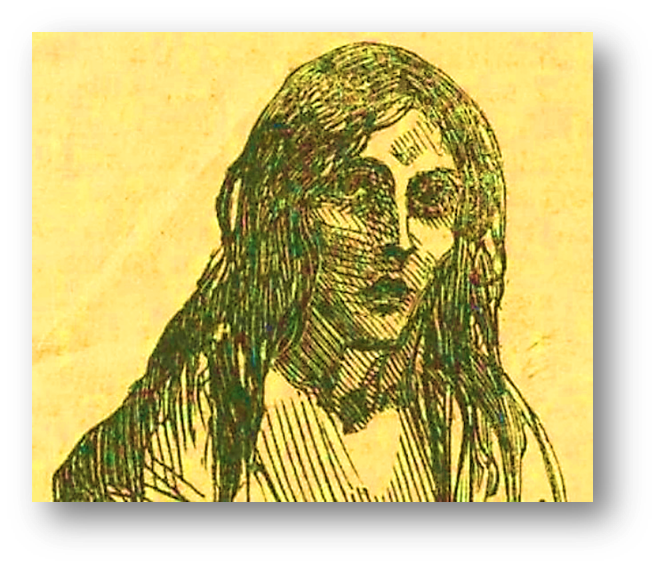
The N68 road that today runs from Kilrush to Ennis passes through the townland of Garraunnatooha (Granatooha), which was home to a woman and her daughters whose depiction in pen and ink by James Mahony became one of the most infamous images associated with An Gorta Mór . Bridget O’Donnel was her name and she told Mahony her family’s story which was published in her own words, unusual for the time.
Her husband had held four and a half acres of land for which they paid £7 and 4 shillings in rent, but the family were put off the land the previous November after falling behind in payments. That was the beginning of their problems. When evicted, Bridget O’Donnel was ill through fever and heavily pregnant and her husband was absent: “Dan Sheedy and five or six men came to tumble my house; they wanted me to give possession. I said that I would not; I had fever, and was within two months of my down-lying (confinement): they commenced knocking down the house, and had half of it knocked down when two neighbours, women, Nell Spellesley and Kate How, carried me out. I had the priest and doctor to attend me shortly after. Father Meehan anointed me. I was carried into a cabin, and lay there for eight days, when I had the creature (the child) born dead. I lay for three weeks after that. The whole of my family got the fever, and one boy thirteen years old died with want and with hunger while we were lying sick.”

While the family lay stricken with fever in the cabin they’d been forced into, two of the men stole the family’s corn and sold it in nearby Kilrush. Whether they were thieveing neighbours or acting on the orders of the landlord is not known. “I don’t know what they got for it. I had not a bit for my children to eat when they took it from me.” It is not known if Bridget or her remaining family survived.
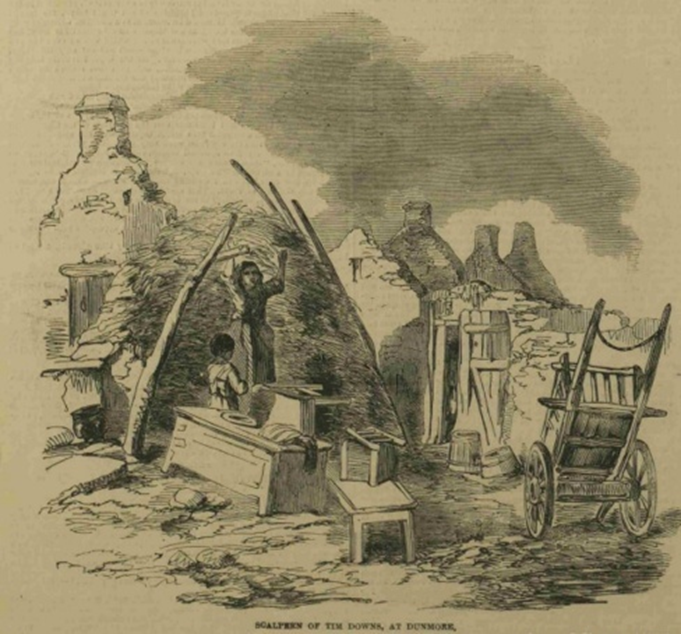
The townland of Doonmore (Dunmore), a short distance from the village of Doonbeg, had been home to the family of Tim Downs for over a century. Despite not being in arrears in regard to rent or taxes, he “was pitched out on the roadside, and saw ten other houses, with his own, levelled at one fell swoop on the spot, the ruins of some of which are seen in this Sketch. None of them were mud cabins, but all capital stone-built houses.”
The Downs family were left fending for themselves in a scalpeen (roofed hole in the ground) next to their ruined home, waiting in fear for the landlord’s men to clear it away and force them out of Doonmore for good. Whilst in Doonmore, news reached Mahony that 37 paupers had drowned on a return journey to Moyarta after having failed to secure relief in Kilrush. Over 40 people had been allowed to crowd onto “a crazy and rotten boat which had been playing on this ferry for the last forty years.” A strong wind had sealed their fate, upsetting the boat and leaving them “immersed in the merciless waters.” Only four people survived.
More pitiful sights awaited in the County Clare countryside. Roofless homes and other ruined dwellings were a constant sight on the journey from Kilrush to Kilkee. Mahony wrote of feeling heart-sick when he got to the townland of Clarefield: “Adults, who appeared idiotic; children, wrinkled with care, so that they appeared like aged persons; and men who should not be worn out, but more helpless than children, with scarcely a rag to cover them, crowded the place. Their habitations were mere kennels.” Mahony returned to Kilrush that night “glad to find a refuge even in it from the more appalling misery of the surrounding villages.”
In the village of Doonbeg, in what is nowadays the West Clare Gaeltacht, he found one half of the village had been destroyed by the landowner: “The people who are yet alive are crowded into dens, or rather dog-holes, where, in a space not sufficient for two persons, twenty are glad to find shelter.”
Mahony interviewed two widows, Judy and Margaret O’Donnel, who had taken refuge in a hole under a bridge which crossed the Doonbeg River. One of the women had three children, all suffering from jaundice, while the other was responsible for five children. Judy O’Donnel and her family were ejected from their home on an estate which was then burnt and levelled becaue she had given evidence against a dishonest Relief Officer – even though her rent had been fully paid up at the time of eviction. Both women and their families retired to the bridge which gave them shelter but they remained “at the mercy of the county surveyor. They are afriad of being ejected even from this spot, and dare not cross the stepping-stones shown in the Sketch lest they should be taken up for trespassing. Judy O’Donnel’s son is dying of dysentry.”

On leaving the Kilrush district, Mahony noted that the population of the area had decreased by over 17,000 in the eight years since the 1841 census. It was believed that a few – “a small fragment” – may have emigrated “but the great majority has been starved out of existence.” Captain Kennedy had reported earlier in 1849 that: “I see masses of the people starving, and the land, which could be made to feed treble the number, laying all but waste.” Relief in the form of food or soup continued to be denied at the insistence of the new poor-law to those, like Michael Considine, who held land: “His wife and nine children died of actual want.” The workhouse in Kilrush, itself denied any appropriate Government support, was a place where people simply went to die: the whole number of deaths there in 1847 exceeded the average number of inmates by 43.
Travelling on to Ennistymon, Mahony witnessed “similar scenes of desolation . . . on both sides of the road, as far as the eye could reach, it fell on ‘tumbled’ and roofless houses.” At a bog at Cahermore there was found “a woman dying of the customary fever which attends on want of food and clothing and the ordinary necessaries of life.”
Crossing the bay to County Galway, Mahony met John Killian at Carihaken and sketched the remains of his dwelling. Despite owing no rent arrears, “the landlord’s drivers cut down his crops, carried them off, gave him no account of the proceeds and then tumbled his house.” His son had cut down sticks from trees that had stood in what was the family garden to help make a shelter only to then be arrested and imprisoned for two months for “destroying trees and making waste of the property.” In the coastal town of Clifden, extreme poverty was found with a workhouse deprived of funds to feed inmates and the poor having largely disappeared along with their houses: “They have not found refuge in the workhouse – they have not been carried away as emigrants; they have either wandered away or have died, or both may have contributed to cause their disappearance.”
Mahony finished his journey in Ennis, the county town of Clare. Wandering through the town’s lanes and alleys he soon came across the most distressed part of the population: “In one small room, not 20 feet square, I found congregated fiteen people, young and old, exhibiting nearly all the phases of want and squalor.” The room was filled with smoke, like a Rembrant scene he wrote, initially making it difficult for Mahony to take in all the details. It was a while before he realised that a child lay dying on the floor of the room. The child’s mother, a widow called Connor, prayed over her son’s emaciated body while family members looked on – an appalling scene captured for eternity by Mahony’s hand.

James Mahony’s account of his travels through the south-west of Ireland in late 1849 laid bare the human devastation apparent in town, village and countryside. His drawings captured the impact of colonial indifference and a pubic policy based on racial and religious hatred. Mahony predicted, correctly, that without a humane shift in British Government policy, things would only worsen for the Irish people: “In such, or still more wretched abodes, burrowing as they can, the remnant of the population is hastenening to an end, and after a few years will be as scarce nearly as the exterminated Indians, except the specimens that are carefully preserved in the workhouse. Those whom starvation spares, disease cuts off.”
‘A CONGREGATION OF BEGGARS’
Scotland was home to 126,321 Irish-born people in 1841. When the census was re-taken in 1851, that number had increased to 207,367, amounting to 7.2% of the total Scottish population. Yet, as Dr. John McCaffrey’s research demonstrated, those figures didn’t tell the full story of the Irish settlement: “. . .in reality it was very much more concentrated in the new Scotland developing in these years in the towns and industrial counties in the south-west and west of the country . . . the already large Irish concentrations in the west of Scotland increased even further.” He concluded that by 1851, with famine having devastated Ireland, “In cities like Glasgow and Dundee nearly a fifth of all inhabitants were from Ireland.”
With 329,097 people registered within Glasgow’s boundaries in 1851, this meant that approximately 65,000 were Irish. Yet the census failed to record the number of children of Irish-born parents born in Scotland. In 1861, the census recorded Glasgow’s increased population at 395,303. It is likely that the number of first and second generation Irish at that time would have made up almost a quarter of the city’s population.
It was common for newspapers of the day seeking to raise alarm at the number of Irish arriving in the city to exaggerate the figures involved, as we often see today where migrants are concerned. It was frequently reported in 1847 that over a thousand famished Irish were arriving at the Broomielaw every week, prompting this alarmist comment from the Glasgow Herald: “the enormous number of Irish vagrants poured in upon us by steamer that arrives in the Clyde threatens to eat us up.” Handley’s research debunked the thousand-a-week figure by pointing out that those arriving included large numbers of temporary harvest workers as well as many who stopped off Clydeside in order to travel on to foreign destinations as well as other parts of Scotland.
John McCaffrey noted that a panic about being submerged or inundated by the Irish was unjustified although there was no doubt that a “mood of crisis” had gripped Glasgow and Scotland about the arrival of so many Irish people attempting to flee hunger and disease: “A sudden jump to a rate of 16,000 per annum was by any standards a frightening experience and one with little need of exaggeration. It represented the addition of a sizeable new industrial town each year in the later 1840s and early 1850s onto a society already struggling to cope with the new levels of social provision demanded after 1845 to sustain temporary claimants for poor relief at a time of economic downturn.”

While Glasgow was a boom town it already had marked social problems. By the 1830s it had the reputation of Britain’s filthiest and least healthy city. Life expectancy was low with typhus outbreaks taking place in 1818 and 1837 on an epidemic scale, while a cholera epidemic had taken hold in 1832. The city was already notorious for its’ sub-standard and cramped housing in the central area. The most frequent killer was lung disease due to the widespread air pollution in the city, making it responsible for a third of all Glasgow adult deaths in the 1850s. Those who lived in the Dear Green Place were especially vulnerable to the impact of sudden economic recession.
Significant numbers of Irish arriving in Glasgow in 1846 and 1847 did not survive long enough to experience life in their new surroundings. Suffering from the effects of starvation, dysentery and diarrhoea as well as typhus (which was quickly dubbed ‘famine fever’ despite the previous typhus outbreaks in the city) many were in urgent need of medical care. Special temporary fever hospitals were set up to treat individuals. Those who provided care and support to the arriving Irish were not invulnerable: by July 1847 four surgeons, three nurses and six poor law officers had all died from typhus in Glasgow.
Priests were also at significant risk. Father (later Canon) Michael Condon from St. Mary’s Parish in the Calton, who would go on to live to the age of 85, recalled in his memoirs what he had encountered in the late 1840s in the city’s East End: “The fever scenes were truly awful. I had often to administer sacraments to the living as they lay chattering, unconsciously, to the corpses beside them. I anointed a family in an open court, in Calton: another, under a tree, at Partick; & a third in a deserted hut or hole at Hoganfield; & others at the stairfoot of closes.” Four of Father Condon’s fellow assistant priests at St. Mary’s died from typhus in 1847, caught whilst ministering to the sick and famished. They are buried in the crypt under the chapel in Abercromby Street.

From St. Andrew’s Church on Clyde Street, Bishop John Murdoch wrote in April 1874: “Four of the priests of this House are now lying: Kelch has passed the crisis: Gallagher is in the balance: whether life or death will be the result is very doubtful. Hanly and Gordon have both taken to bed today with all the symptoms of fever on them. The sick calls at all the chapels are very very numerous, sometimes not less than 80 or 100 a day . . . We are fatigued and fagged almost every day. I hope the present visitation will soon pass or we’ll be all Kilt [sic].”
Many have detected a lack of sympathy and even hostility in some of the Bishop’s comments about the large numbers of fellow Catholics arriving at the Broomielaw and spreading out into the city: “The starving Irish are flocking into Glasgow by every boat and are literally ruining us.” In a letter sent in October 1848 he wrote: “. . . still times are bad and the best of our people continue to cross the Atlantic so that by and by we will be left a congregation of beggars.” In the next decade the difficult relationship between the Highlanders who occupied the senior positions in the Catholic Church and the increasing numbers of Irish-born parishioners and priests would be increasingly exposed.
In 1845 there had been 8,259 burials in Glasgow. In 1847 this more than doubled to 18,886 and 1848 saw the return of water-borne cholera to the city which, along with ‘famine fever’ (also referred to as ‘Irish fever’) was unjustly blamed on the new arrivals. Soup kitchens set up in St Enoch Square and at St. Andrew’s Cathedral in 1847 were feeding well over 5,000 people emaciated by disease and want on a weekly basis. It looked as though the city was on the brink of disaster.
A variety of factors combined to avert this: the numbers of people leaving Ireland for Glasgow began to decline; mortality levels stabilised; the anticipated arrival of thousands of destitute Highlanders facing famine in the north of Scotland failed to materialise as many went into exile; and the end of a serious economic recession in 1849 saw a rise in work in both city and countryside. This, according to Devine, “more than any other single factor made for better prospects for poor Irish immigrants who, long before 1846, had become well-established in general and casual labouring jobs in Scotland in construction, agriculture and industry.”
Poor relief, distributed through parochial boards, provided initial financial support to those suffering the most. Yet, as this was being paid for through local rates rather than central government, there was no desire to keep feeding and funding those most in need. After spending £9,092 in 1847, the amount spent on poor relief by the Glasgow Parochial Board was reduced to a mere £1,107 in 1848. While 13,125 Irish-born claimants had been supported in the Barony Civil Parish in 1847 (the High Street district), this dropped to 2,709 a year later.
In addition, those found begging on the streets of Glasgow were arrested and, if Irish, often forcibly repatriated across the Irish Sea. Research suggests that almost 50,000 Irish paupers were expelled from Scotland between 1845-54. Handley recorded a number of instances of people who had been resident in Scotland for more than two or three decades being taken away from their families and sent to Ireland after poor relief applications were rejected.
The message was clear: for the Irish to survive in Glasgow they would have to rely on their own efforts.
Coming soon: PART TWO
‘THE HEADQUARTERS OF POPERY IN THIS CITY’
Read more Celtic history articles from The Shamrock here: https://the-shamrock.net/the-shamrock-online/

Issues 1-10 of The Shamrock fanzine can be bought here: https://the-shamrock.net/magazine/
 the shamrock