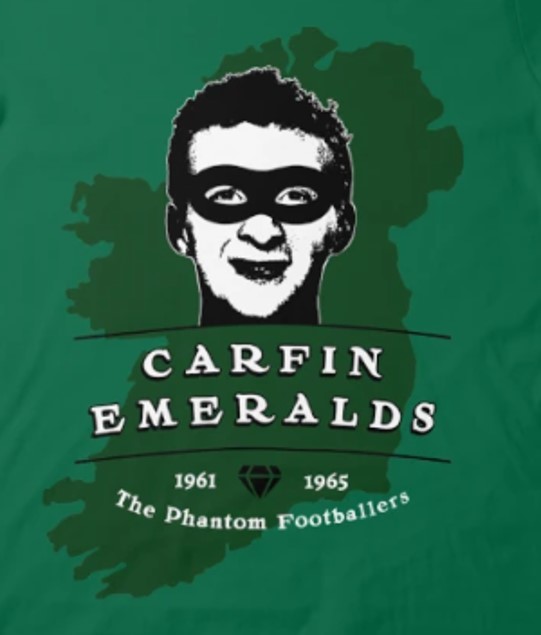
The Incredible Story of the Carfin Emeralds
There are always two stories my Dad likes to tell whenever the name of Jimmy Johnstone is mentioned. The first concerns a Lanarkshire primary schools match in the early 1950s between St Francis from Carfin and St Columba from Viewpark. As reserve ‘keeper for St Francis, my Dad was called into action at half-time when they were already losing 4-0. The first-choice keeper had suddenly felt unwell and couldn’t continue. My Dad remains suspicious that he was wanting to avoid further humiliation at the hands of a tiny, red-headed St Columba’s winger who was running the show, proving impossible to dislodge from the ball and setting up goal after goal.
Even at such a young age the man who would become known globally as ‘Jinky’ was making a name for himself on the football field. My Dad remains proud of the fact that he stemmed the second-half tide from Viewpark, conceding only two more goals.
The other Jinky story he likes to tell is a lot more fanciful – or so I thought. Having grown up in Newarthill, Lanarkshire, my father witnessed a new parish called St Teresa’s being carved out of the large Carfin parish under the leadership of a young Irish priest – Father Jack Gillen – from 1956 onwards. Within four years an impressive new church had been built dominating the village and some time later, my father recalls, stories started circulating of Jinky and other renowned footballers playing summer tournaments in Ireland to raise funds for St Teresa’s. Even more unusual than that, the players used masks, false beards, wigs and even wore make-up to disguise their true identities. He told me that the team was called the Carfin Emeralds and they’d been christened the ‘phantom footballers’ in the Scottish press which was desperate to find out the identities of those involved. And at the heart of it all was Father Jack. It was a story that was simply too far-fetched to be true. Wasn’t it?
When I moved to Glasgow in 2000 I visited the Mitchell Library and looked up some newspapers from the early 1960s, but could find scant mention of this phantom team. Dad couldn’t remember the exact year or newspapers involved. I looked through various player biographies and other Celtic books but found no mention of Jinky and the Irish summer cup escapades. The Carfin Emeralds drifted out of my mind.

DONEGAL NIXERS AND A GOLDEN ERA
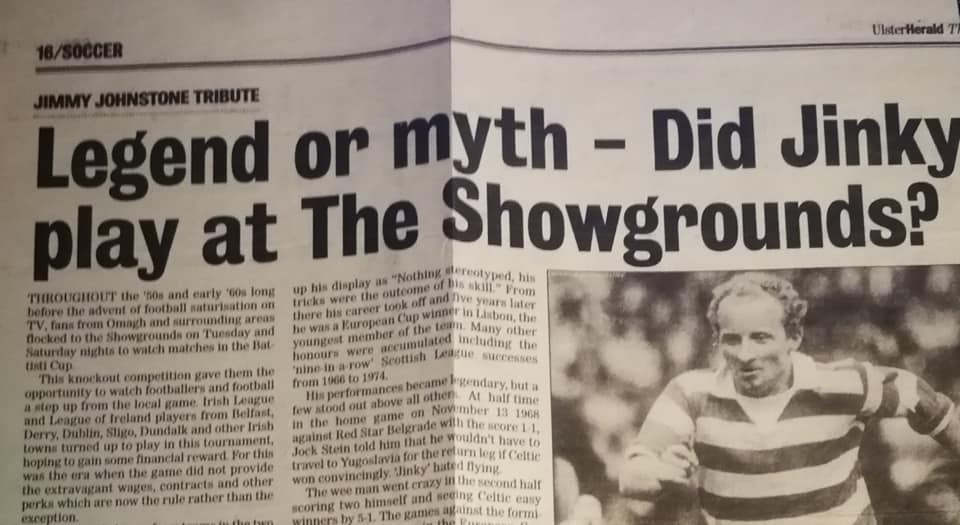
When Jinky died in March 2006, obituaries of the man dubbed ‘La Puce Volante’ (the Flying Flea) by the French press and considered by many to be the greatest ever Celtic player appeared in newspapers across the world. One such tribute was sent on by my pal Dessie from his hometown of Omagh in County Tyrone. The local paper, the Ulster Herald, noted that in Ireland ‘his memory will be especially revered’ and queried whether, as local legend had it, Jinky himself played at The Showgrounds in Omagh before the site was turned into a shopping centre.
The newspaper explained that during the era of the popular summer cup tourneys of the 1950s and 1960s Omagh had its own competition – the Battisti Cup, put up by a local businessman of Italian heritage – which attracted great crowds and lots of speculation as to the identities of the players taking part. It noted that it was ‘the appearance of a mercenary band all the way from Glasgow that caused the biggest wave of excitement among the regular attenders’ and identified the team as the ‘Carfin Emeralds.’ I sat up. The piece went on to explain that the Emeralds had been ‘gathered up literally by the parish priest of the Carfin parish’ who was a Donegal man who would ‘kill two birds with one stone by taking his team on from Omagh to Moville to play in the local Kennedy Cup competition on the Sunday afternoon.’
Could this be the story that my Dad had mentioned years before? Dessie had highlighted a passage which brought a huge smile to my face: These Scottish representatives caused a massive stir because they wore masks, false beards and moustaches to protect their identities.
It had to be the same story! There was the Donegal connection and Father Gillen, footballers in disguise and, of course, Jinky. But was it all true? The writer of the Omagh Herald piece stated that ‘this was something I and others have been unable to ascertain for certain . . . it is likely that as his reputation grew so did the stories linking him with summer football in Ireland.’ At least it was a start.
I began searching afresh online and came across a promising lead in a column that the Derry writer and activist Eamon McCann wrote in the Irish music magazine Hot Press. It took an age to get my hands on a physical copy, but it was well worth the wait. In reference to Jinky’s recent demise McCann had noted a ‘curious omission’ in the mainstream obituaries which listed the clubs he had played for: ‘Celtic, San Jose Earthquakes, Dundee, Shels and Elgin City. But no reference to Carfin Emeralds.’ He went on to explain that the Emeralds dated from ‘the golden era of the North West Summer Cups, when every Donegal townland with a sprinkling of get-up-and-go hosted a knock-out football competition for sizable cash prizes.’ There were prize monies in excess of £10,000 at today’s prices and crowds of over 5,000 for some fixtures.
McCann noted how some Scottish professional players who were ‘back in ancestral Donegal for the summer’ starred in many of these summer tourneys to gain some extra money in the close season and often used false names ‘so as not to alert their regular employers to the holiday nixer.’ But there was something different about the team from Carfin:
The Emeralds’ possibly unique distinction was that they played in masks. Fans used to stand on the sidelines debating whether the guy who’d just fallen over the ball could really be Ian St John. But there was never any doubt about Jinky.
So Jinky had been involved in these Irish summer cups – but when exactly? And where? Details were tantalisingly absent but questions were in abundance. The most persistent in my mind was: why the disguises?

Jinky made his Celtic first-team debut in March 1963 but had been signed by the club aged 17 in November 1961 and allowed to spend the remainder of that season with the junior team Blantyre Celtic. If he and any other Celtic player were taking part in these tournaments in Donegal and Tyrone was it likely they would be caught? Would the omniscient Celtic chairman Bob Kelly permit such close season shenanigans – even those in aid of the Catholic Church? What about the football authorities?
I found some answers in a book written by former Third Lanark and Newcastle United forward Dave Hilley called What Game? Hilley wrote of how he and some Third Lanark team-mates began holidaying together in Spain’s Costa Brava in the late 1950s and ended up playing games against local teams which attracted decent crowds. Spotting an opportunity to make some money to top up their reduced summer salaries, Hilley and his team-mates invited pals including Celtic’s Billy McNeill and Mike Jackson along, borrowed jerseys from the kit man at Cathkin Park, stitched Scotland crests on them and started taking part in challenge matches in front of crowds in excess of 10,000. As the Scottish players were receiving half the gate money, this was a profitable endeavour – and Lloret de Mar was a long way from Park Gardens and the prying eyes of the SFA.
After playing a team made up of reserve players from FC Barcelona in 1961, a Scots holidaymaker had his photo taken with the players and promptly sold his story to the papers on his return home. At a disciplinary hearing in Park Gardens in March 1962 each of the professional players involved was fined £50 – more than month’s wage for most of them. The football authorities did not look kindly on unauthorised games involving players under contract to member clubs.
Now it made sense why, even in the quiet hinterlands of Ireland’s north-west, players would try to keep their true identities under wrap, avoid the wrath of the football authorities back home – and keep their pay packets intact.

TIGERS AND BULLOCKS – ALIVE! ALIVE! O!
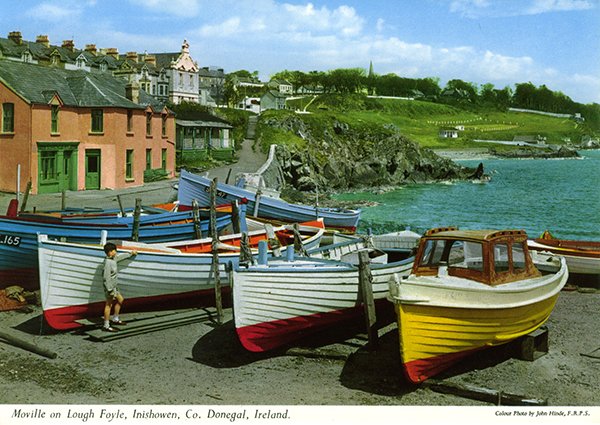
I looked for more clues about these summer cups that proved such big draws across the Irish Sea. Plenty of tales abounded. As well as Moville and Omagh there were tournaments in Buncrana, Castledawson and Strabane; there was the Ramelton Cup, the Raphoe Cup and the Convoy Cup. The biggest tournament of all, it was clear, was the Kennedy Cup in Moville on the Inishowen peninsula, less than 20 miles from Derry city.
There were interviews online with a legend in Donegal football circles: Bobby Toland. He had put together a team called the Kildrum Tigers in St Johnston, County Donegal to play in the summer cups that were up for grabs. In 1957 the Tigers reached the semi-finals of the Buncrana Cup with a team featuring five Scottish professionals including Celtic’s Charlie Tully and Pat Crerand. Both of Crerand’s parents were from Donegal and he spent every summer away from the Gorbals in Gweedore. When he was older, he turned out regularly for the Tigers – even after he’d won international honours with Scotland and had transferred to Manchester United.
Bobby Toland recalled that on one occasion Pat had paid for a taxi to take him from Annagry to Moville to ensure he didn’t miss a Kennedy Cup encounter. There was another time when Pat shockingly switched sides in the Raphoe Cup to play with his Celtic team-mates Frank Haffey and Jim Conway against Kildrum, with Bobby later discovering that the opposing team manager had sold a bullock to raise the funds to entice Crerand to join them! What price loyalty?
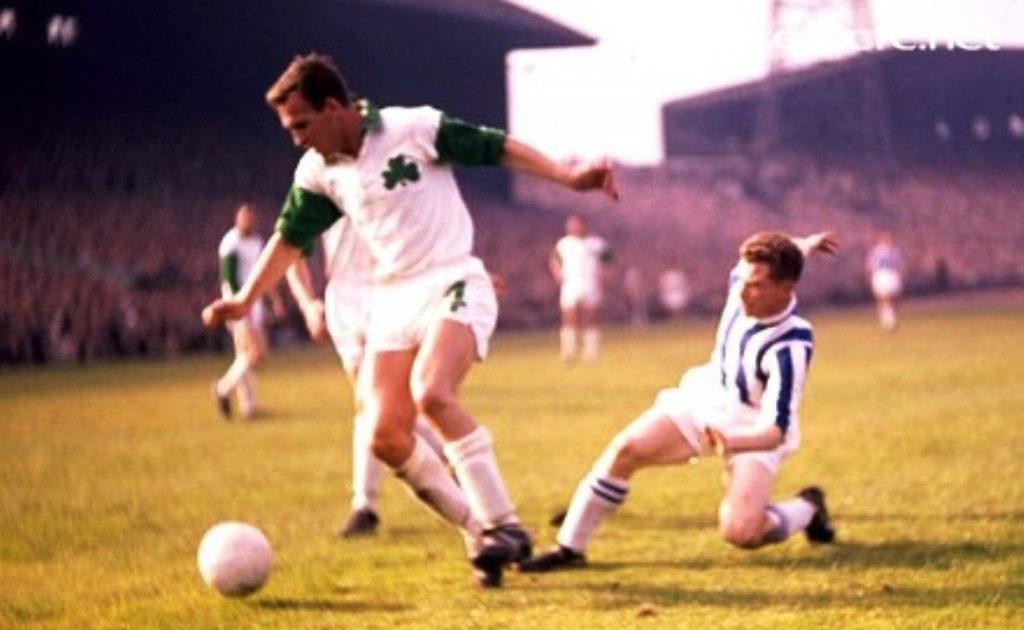
In his Hot Press column Eamon McCann had recalled, with fondness, the story of how Kildrum Tigers had made it to the final of a summer cup one year – only to discover that the final tie clashed with a European qualifier that Manchester United were playing away in Czechoslovakia. This meant they would be deprived of the services of Pat Crerand when they were needed most. A friend of McCann’s proposed that Kildrum should lodge a formal protest with UEFA on this controversial issue of fixture congestion – overlooking the important fact that Crerand’s registration lay at Old Trafford club and not in Donegal. McCann records that no official protest was sent because “Sadly, he was over-ruled by conservative elements on the Tigers’ committee.”
DIVINE INTERVENTION
Time was passing and, back in Omagh, local minds had been set on establishing if Jinky had in fact played at the Showgrounds in the ‘60s. It was now 2009 and the Ulster Herald had returned to the story. Dessie had sent me another clipping this time with the heading: ‘Great Scot! Great Celt did play in the Battisti Cup.’
Word of the story had travelled to the south coast of England where an Omagh exile, Father Colum Kelly, was now resident. Father Kelly had contacted the paper to advise them that he could confirm that Jinky had turned out for the Carfin Emeralds in the Tyrone town. His source? The man himself!
I spent most of my active ministry in Yorkshire. In the mid-70s Jimmy Johnstone played for Sheffield United in the twilight of his career. He was a regular attender at Sunday evening Mass and afterwards at the Brown Bear across the street where he kept us entertained with recollections of his colourful career. When I told him I was from Omagh he confirmed he had played summer football there.
It was not quite from the confessional but it was just as reliable – there was surely no way he would have lied to a priest. A significant piece of the jigsaw was now in place. Then another fell in quickly alongside it.
I was carrying out occasional Google searches to see if there were any new mentions of the Carfin Emeralds online when I struck gold on www.jimmyjohnstone.com. On a tribute page where the public could upload memories of Jinky, two sisters had posted a story – as told to them by their uncle – of how their father Francie, a player with Third Lanark who hailed from Newarthill, had been approached by Father Gillen in the early 1960s and told of his plan to enter a team in the Kennedy Cup in his hometown of Moville. ‘You will be the captain of the Carfin Emeralds!’ was the direction from the priest, which Francie happily accepted. It was through the Emeralds that one night Jinky had ended up in the Francie’s family home in Newarthill. This night had entered family folklore as, according to Francie’s brother, it was ‘the only time your grannie was taller than any other adult in the room when Jimmy was there, she just loved him.’
I phoned my Dad to tell him the news and, through my Uncle Jim who still lives in Newarthill, it was confirmed that this had to be Francie Howley, a prominent footballer from the village during that era. Francie had played senior football with Hamilton Accies and Third Lanark and had also turned out for the junior outfit Thorniewood United – who played in Jinky’s village of Viewpark. In season 1961-2 Francie was playing at centre-half for Coltness United in Wishaw and they had a young full-back who was in the process of making a name for himself: Tommy Gemmell. It made perfect sense for Father Gillen to approach a parishioner such as Francie with contacts at various levels of the game to organise a team to try and bring one of Ireland’s summer cups back to Scotland.
A couple of months passed and I then had a slice of tremendous luck – after what appeared to be a set-back. My Dad had remembered that Father Gillen had an assistant in the early years of St Teresa’s who came from Viewpark originally, which might explain Jinky’s involvement in this adventure. Father Francis Darroch had been the young curate in question and I discovered that he was still alive and listed among the retired clergy in the Diocese of Motherwell. Although it was 2009 and nearly 50 years had passed since the ‘ghost team’ of Lanarkshire had played, this was an intriguing lead. I wrote to the Chancellor of the Diocese who promptly responded to advise that Father Darroch was now in a nursing home and, due to failing health, he would not be able to assist me. This was unfortunate but not entirely surprising given that the retired priest was almost 80 years old.
I thought that was the end of that line of inquiry until I read the rest of the Chancellor’s email. He went on to tell me that he recalled the story of the footballers with the false beards and masks who had gone to Donegal from Scotland to play in illicit games. This had generated a lot of press coverage in Scotland at the time. However, the main reason he remembered story was because his own brother had been a Carfin Emerald! That was how I ended up meeting Pat Cassidy.
HERE COMES THE SUMMER
Pat could not have been more helpful. He shared his own newspaper clippings from the summer of 1962 which he had largely spent in Ireland as a ‘phantom footballer.’ Pat came from Cambusnethan and had been playing for junior side Coltness United alongside a certain Francie Howley. It was Francie who had approached him with the offer of a slot at outside-left as an all expenses paid trip to Ireland and the opportunity to win some silverware while raising much-needed funds for a local Catholic parish. Pat was in his early 20s at the time, unattached and working for a local bookmaker. He jumped at the chance.
Pat explained that the Emeralds would play in Omagh on a Saturday night and then Moville on a Sunday afternoon. The original plan had been to travel over at weekends but, after a victory in the Battisti Cup (over what Pat recalls was a ‘Linfield 11’), enough prize money had been secured to enable them to stay for a week, being put in a bed and breakfast in Moville arranged by Father Gillen. When not playing in Omagh or Moville or in one of a number of one-off friendly encounters that were arranged, the Emeralds were taken on days away and according to Pat ‘treated royally’ throughout their stay in Inishowen.
Pat confirmed that the Emeralds had taken to the field wearing false beards, moustaches and face masks. The players were well aware of the heavy fines dished out by the SFA earlier that year although, for junior players such as Pat, there was less concern (the three junior players involved in the Lloret de Mar games were not fined by the SFA). In addition to disguises the players even used false names – Pat was given the surname of Smith to help keep up the subterfuge.

In Pat’s Carfin Emeralds side of 1962 the best-known player was the former Scottish international Frank Brennan who spent 12 years as centre-half in the most successful Newcastle United side in that club’s history, winning the FA Cup in both 1951 and 1952. Frank came from Annathill, near Glenboig,in Lanarkshire and at the time was 38 years old. He had retired from the playing side of the game. He and his family had regularly holidayed in Moville (and his daughters still do).
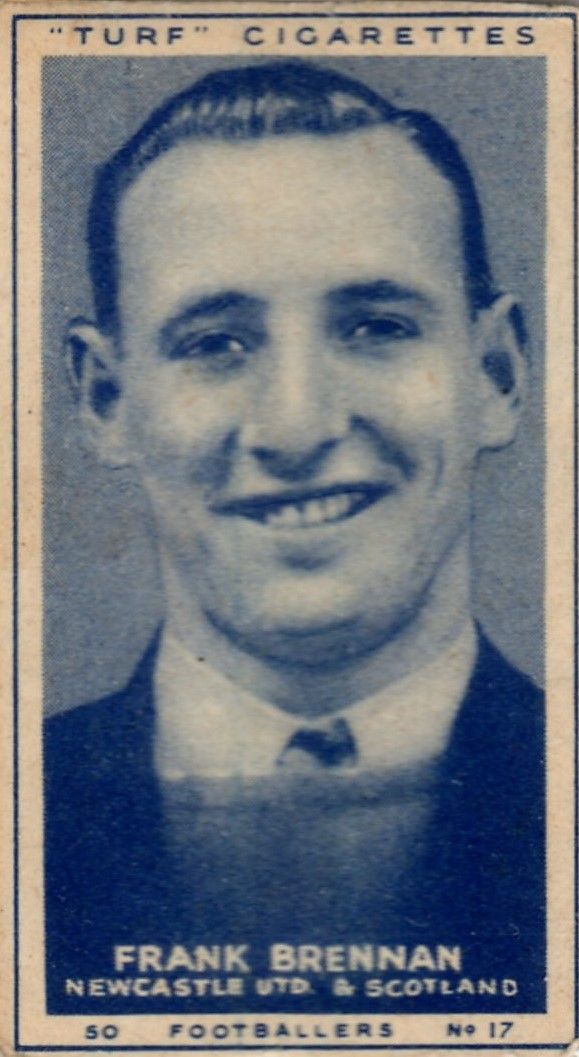
Other team-mates that Pat recalled from the 1962 Emeralds were Tommy Morrison, an exciting midfielder who had just joined Aberdeen. Tommy came from Croy and his father Jock was part of the famous Celtic side that won the Empire Exhibition Cup in 1938. There was Pat Waters who had played youth football with the Glenboig Joes and was with Dumbarton at the time. Tony Weldon was another Croy boy who playing with Petershill juniors, and Tony Canning was a junior player from Carfin.
I couldn’t put the question to Pat Cassidy fast enough: ‘Was Jinky one of your team-mates?’ No, was the answer, leaving me crestfallen. Then Pat explained that his team-mates had told him that Jinky had played for the Emeralds the year before Pat joined up – but had to step back due to being hounded by photographers.
With Kennedy Cup prize money totalling £1,000 that year, the first Carfin Emeralds team – including JInky – had travelled by ferry to Ireland in the hope of raising funds for St Teresa’s. They met with stiff opposition, failing to reach the latter stage of either Kennedy or Battisti Cup, although their presence had helped boost the overall tournament attendance in Moville beyond the 10,000 mark, much to the organising committee’s satisfaction. It was the Trojans from Derry who won the 1961 Kennedy Cup, beating the holders Albert Celtic (Belfast).

The following year, in 1962, Pat Cassidy and the Emeralds travelled in style and were flown rather than ferried across the Irish Sea. However, even before they had left Renfrew Airport they were already being stalked by newspapermen and photographers. Their plane was delayed due to the presence of so many pressmen, although they reached Ireland eventually as the Belfast Telegraph reported under the headline ‘PHANTOM FOOTBALLERS ARRIVE’:
After months of mystery, Scotland’s phantom footballers – the ghost team from Lanarkshire, Carfin Emeralds – arrived today . . . but still no players’ names were mentioned as they landed at Nutt’s Corner Airport. They emerged from a van at Renfrew Airport, Glasgow just before 7am as a BEA Viscount was about to take off. Fifteen of them – players and officials – rushed to the reception desk. After hurried talks the airliner was radioed to wait. It waited half an hour. Thirteen of them got on board.

Over in Moville, Eamon Gillen of the town’s Foyle Hotel was fielding questions from the Telegraph about a relative of his:
Holidaying in Moville at present is Mr Gillen’s brother Rev. J Gillen, a Roman Catholic curate at Carfin, outside Glasgow. Said Mr Gillen: ‘He will not speak to the press as he has been pestered by reporters since Carfin first came over here. I can’t understand why such a fuss has been caused.
The newspapers were clearly on the scent of a big story, having missed out on it the year before. In an interview with another Irish newspaper, Eamon Gillen revealed how the Emeralds were making a renewed bid for Kennedy Cup glory and the prize fund on offer with a little help from some friends: ‘Carfin will possibly have a better side over this time. They are arriving by plane – and bringing supporters with them as well.’
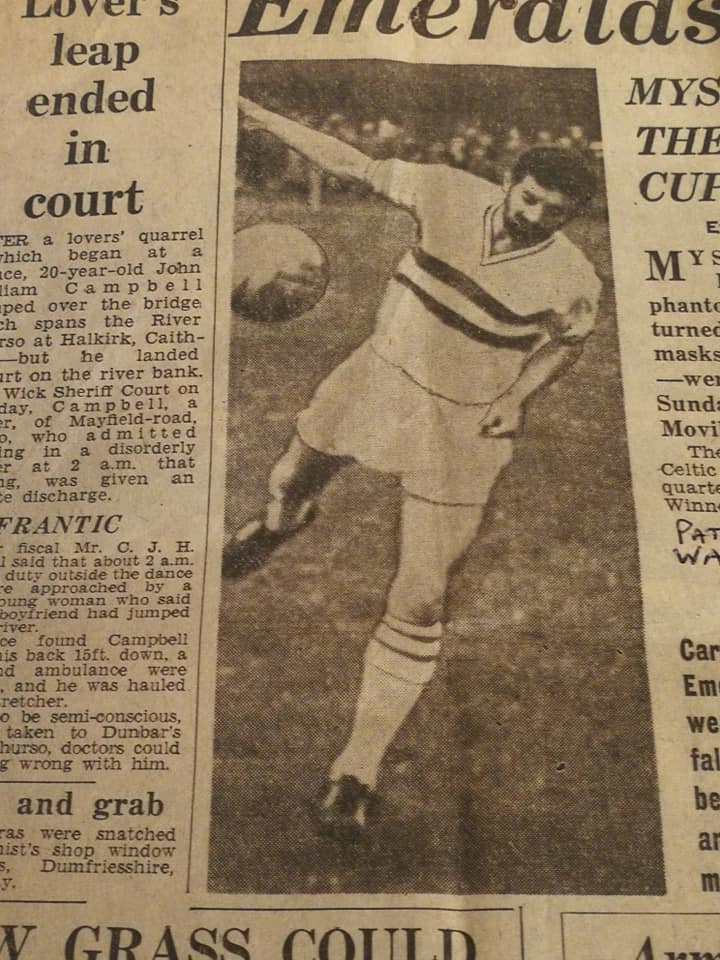
Once again the press fixated on the lengths that the Emeralds went to to keep their identities under wraps:
Soccer stars anonymous . . .That’s the title of a group of Scottish players who will be back in Ireland this weekend . . . Lat time they were here their officials refused to disclose to talent scouts and to Pressmen the names of their players. It will be the same this time too. Even in Scotland. Pressmen have been unable to obtain any information. They won’t allow photographs to be taken either.
MOVIN’ ON UP – TO MOVILLE
It was truly astonishing that a picturesque seaside town on the Inishowen Peninsula could put together a prize fund of £1,000 (approximately £23,000 today) which rightly earned the Kennedy Cup the title of ‘Ireland’s premier football competition.’ The local businesses involved came up an array of fundraising ideas to help them put this pot of gold together. In 1962, for example, they organised a prize draw for a two-year old chestnut pony called Sweetheart. When Nellie McGhee won the pony she opted for the alternative £50 prize instead as she was unable to accommodate a pony in her Derry home, leaving the committee treasurer (Eamon Gillen again!) to forlornly tell the local papers: ‘I suppose we could sell the pony but we would prefer to keep it as a prize for next summer’s competition if we can get someone to look after it during the winter.’
I needed to find out more about the competition and the people behind it. I recruited the help of my pal Ally from Cushendall, County Antrim. After making contact with the local librarian in Moville, Ally was directed to a shopkeeper in the town, Mr Gerry Lynott, who had been one of the Kennedy Cup organisers in the 1960s. Ally made contact with Gerry initially by phone and then, by happy coincidence, my brother-in-law was offered accommodation for a summer break for our families through friends of his parents – who had a holiday home in Moville, of all places. Another stroke of good fortune. I couldn’t wait to make my way to ‘the shop with the big tree’ where Gerry, who was then 80 years of age, gave us the warmest of welcomes and regaled us with his memories of the Kennedy Cup and the masked men of Carfin.

Gerry explained that the Kennedy Cup began all the way back in 1935 when Jack Kennedy, a Belfast businessman, donated the trophy in memory of his parents who were from Moville originally. It was a local annual football tournament and in 1942 the total prize money was £16. Gerry’s father was the tournament secretary from the outset.

Gerry recalled that in 1950 a team had come from Glenboig in Lanarkshire to claim the winners prize of £50. They were the parish team of St Joseph’s Church and led by the assistant parish priest – a certain Father Jack Gillen. Glenboig St Joes made it to the final but couldn’t overcome the Derry team Rossville.

The Gillen family owned the Foyle Hotel which was one of the local businesses represented in the Moville Development Committee, along with Gerry’s family’s newspaper shop. The Gillen family had three sons and it was the oldest, Harry, who first had the idea of using funds from the Kennedy Cup to support missionary work in the Far East in the 1930s. This was before Harry joined the priesthood (becoming a missionary himself) in which he was followed by younger brother Jack. Eamon was the brother who managed the hotel and Gerry recalled that it was his idea in the late 1950s to charge teams to take part which meant, along with contributions from the local businesses who would benefit from increased numbers of visitors to Moville, they could guarantee £1,000 prize money for the Kennedy Cup based on increased attendances. Better teams (including some holidaying professionals) were attracted by the greater prize money which in turn generated bigger crowds. There was also increased competition from summer cup tourneys elsewhere in Ireland’s north-west: increasing the prize money would keep Moville ahead of the chasing pack.

Gerry explained that at the time, summers in Moville and Donegal were awash with visitors from Scotland, second and third-generation Irish who were visiting family. Gerry’s shop made enough from tourists in the summer months to keep the business profitable for the rest of the year. The thirst for football from the tourists was unquenchable – and that included some famous names. Celtic’s McPhail brothers, John and Billy, who made their mark in the 1950s, holidayed in Moville as youngsters and returned as adults. Gerry could vouch for this as the McPhail family stayed in his mother’s house each year.
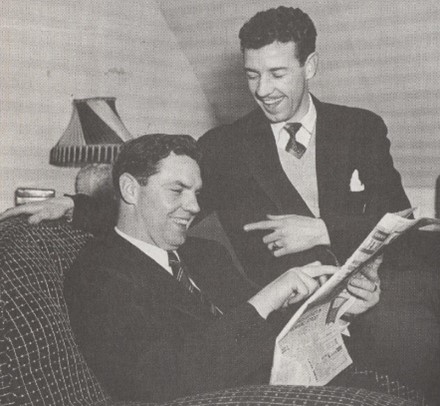
The McPhails had played in the Kennedy Cup but also in the unofficial Scotland v Ireland challenge games which took place every Tuesday and Thursday evening down in the Bay Field pitch on the shore of Lough Foyle, then home to the town’s Moville Celtic. It was these challenge matches that attracted the Middlesborough forward Neilly Mochan, future Celtic legend, to Moville from his holiday home in Buncrana, in search of a game of football. Neilly had to take a pair of football boots from a pile in the corner of the egg store where the players changed before heading to the Bay Field. Gerry recalled that Neilly later Neilly phoned the organisers after one of these ‘international’ encounters to tell them he’d never worn a better pair of boots in all his days. The boots were sent off to Buncrana the following day as a gift to The Moch.
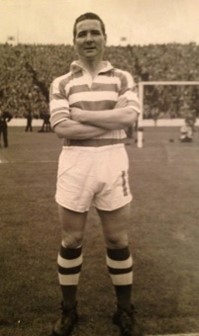
Other Celts who pitched up in Moville were the accomplished Matt Lynch, playing long after his retirement, who was left near-crippled for the remainder of his holidays by his exertions in the Bay Field! Gerry himself had been replaced in Moville Celtic’s reserve team one summer by none other than Bobby Evans, a leading Celt of the ‘50s. Bobby enjoyed the experience so much he offered to play one more game on the day he was due to leave for home – when he missed a last-minute penalty he almost missed the taxi waiting to take him and his family back to the airport outside Belfast! The Coronation Cup-winning keeper, Johnny Bonnar, was another familiar face at the summer games in Moville but Gerry’s favourite memory from the era was when two legends of the game, Irish international forward Peter Doherty and Celtic and Scotland’s Jimmy Delaney, faced each other across the Bay Field in one of the challenge matches. A photo still survives of the two shaking hands before the game’s start.
SETTING THE HEATHER ALIGHT
When Father Jack Gillen heard from home in 1961 that the total Kennedy Cup prize money had been increased to £1000, he could have been forgiven for thinking that this was a sign from above. He had just overseen the building and opening of the impressive new chapel in the centre of Newarthill and needed to come up with ideas to defray the building costs while still supporting over 2,000 parishioners. He had taken the Glenboig Joes all the way to the final in 1950 – surely he could go a bit further with a little help from some friends?
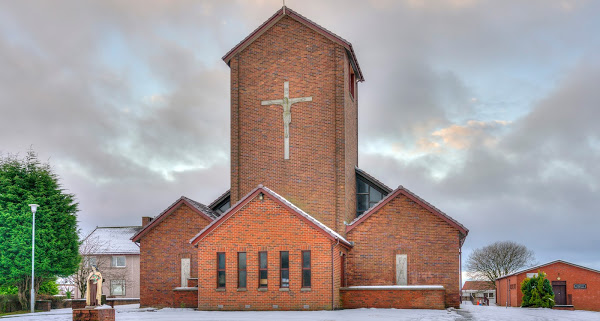
Following his death in 1995, the Donegal Democrat recorded that Monsignor Gillen was ‘well known for his love of soccer and was an avid Glasgow Celtic supporter.’ At his requiem mass, his good friend Bishop Joseph Devine told the assembly:
Five places were dear to the heart of Monsignor Jack Gillen. The first was Donegal, to be more specific, Moville. The others were Glenboig, Newarthill, Rutherglen and Celtic Park.
When Celtic won the big cup in Lisbon it was a holy day of obligation – and Father Gillen had moved the scheduled Mass time back in the evening to ensure that everyone (himself included) could enjoy the full game and, hopefully, post-match celebrations. The Moville man loved Celtic and there is no doubt that his Kennedy Cup masterplan involved using the services of some Celts.
The mere suggestion that Celtic players might be involved would bring fans in Donegal and beyond flocking to the Bay Field. Securing the appearance of Celtic starlet Jimmy Johnstone was a masterstroke. The speculation around his presence and other possible Celts and professionals provided press coverage for the tournament on a scale that money could not buy. In the words of Gerry Lynott, it was Jinky’s name that ‘set the heather alight.’ After his 1961 appearance, ‘The next time they were back you couldn’t move in Moville – the whole countryside was here to see the Celtic player.’

In 1962 though, Jinky couldn’t run the risk of being caught out by the press now he was a Celtic signing. Without him, the Emeralds got off to a great start in both summer cup tourneys they entered. The first Kennedy Cup game saw an emphatic 11-1 victory while in Omagh there were Saturday night victories over Tonnage Dockers from Derry and Belfast Swifts, the Emeralds winning 4-2 in each game. Pat Cassidy and his team-mates were led to believe that the Swifts were in fact a Linfield team and the Emeralds were rewarded for winning that particular tie with an extended stay in Moville.

It wasn’t only the Carfin team who were proving a draw. When Boville from Belfast beat Kildrum Tigers 3-2 at the Bay Field, the biggest crowd of the tournament to date watched Pat Crerand and his team get knocked out. With the Emeralds being drawn against Albert Celtic (winners in 1960) in the quarter final, the Donegal Democrat reported that ‘all over Inishowen interest in the competition is reaching fever pitch.’ The paper also reported the sizeable support for the Emeralds:
Hundreds of supporters are travelling over with the Scots team which will get a big ovation from many of the thousands of Scottish holidaymakers now in the country.
The Ulster Herald reported on the celebratory scenes on show after the Emeralds beat the Belfast Swifts in Omagh: ‘As the Carfin side left the field a crowd of Scottish visitors gathered round and gave them a terrific reception.’ Of course, the fans themselves were unaware exactly who they were congratulating, as the ‘camouflaged Carfin side’ that had taken the field were ‘almost non-recognisable.’ Big Frank Brennan did not bother with any disguise as he had retired from the professional game by this point and Pat Cassidy, who found his false beard kept falling off, decided to discard because as a junior player he thought it unlikely any action would be taken against him.
‘The Diarist’ in the Donegal Democrat noted that the Emeralds ‘looked more like entrants in a fancy dress parade’ as they engaged in ‘a leg-pull at soccer football legislators who take themselves and the game so seriously.’ It wasn’t only the pressmen who enjoyed the sight of the ‘phantom footballers’ strutting their stuff in attempted camouflage:
I could see that the promoters of the competition also enjoyed the gimmick. How they must have scratched itching palms at all the publicity it brought around the competition. Not Moville alone, not Inishowen or Donegal, but practically all Ireland, including the Six Counties and not a small bit of Scotland, are now interested in Moville and this extraordinary soccer competition. What a tourist boost it all is for this delectable seaside resort.
On Sunday 22nd July 1962 Carfin Emeralds faced Albert Celtic on the Bay Field and were struck by the sight of some of their Belfast opponents wearing false goatees and beards in apparent mockery of the camouflaged Emeralds. The crowd of 2,500, paying 2 shillings each to see the game, enjoyed the joke. Not long after kick-off, Frank Brennan mis-judged a pass-back to his keeper and overhit it, resulting in an opening goal for Albert Celtic. Two minutes later a fierce shot form Celtic’s outside-right was palmed away – into the Emeralds’ net. Only eight minutes had been played and Carfin were 2-0 down.
Slowly but surely the Emeralds got into the game. They were a ‘fast moving and fit combination’ although they appeared hampered by the short pitch. One goal was pulled back before half-time. Stalling tactics adopted by the Belfast team after the goal was conceded resulted in booing from sections of the crowd. During the interval there was an incident with a photographer from the Belfast Telegraph who had started snapping away at the Emerald players on their break. The players reacted by throwing lemonade at him while one player threw a punch and another kicked out at the snapper. ‘The Pressman was able to get away only when a couple of other members of the Carfin side came to his assistance’, reported an unhappy Telegraph.

Seven minutes after the re-start, the Emeralds equalised through their unidentified centre-forward. Tackling then became ‘over-keen’ as each team fought for dominance and tempers began to fray. In the 70th minute the referee flashed a red card, sending off a Celtic player after a crude challenge. The initiative had now passed to the Emeralds but they failed to take advantage. Twelve minutes from the end the Celtic inside-right broke away and scored a surprising clincher. Ten-man Albert Celtic held on for a well-earned 3-2 victory to send the Emeralds back across the Irish Sea.
‘EMERALDS ARE WALLOPED’ was the headline in the following day’s Scottish Daily Express. That was a little unforgiving, as were the Albert Celtic fans in attendance from Belfast at the Bay Field who ‘did the twist on the touchline and then sang for the benefit of the mystery Emeralds ‘Will Ye No’ Come Back Again?’’ The Strabane Chronicle noted a sense of the absurd regarding the spectacle of the Emeralds and their Kennedy Cup exit:
False beards and moustaches, blackface make-up; the pantomime gimmicks introduced at soccer games in Moville and Omagh at the weekend underlined the absurdity of summer soccer in the north-west . . . with all their gimmicks and attempted secrecy, Carfin Emeralds said goodbye to Moville’s Cup. But perhaps the Moville Committee regretted their departure as they counted up the gate receipts which must have touched £350 – all paid to see the beards, the moustaches and perhaps some to see the football.
The Emeralds weren’t finished though. A fortnight later they were back in Omagh taking on another Belfast outfit, Washington United, in the Battisti Cup. Carfin benefitted from an own goal on that occasion, taking the lead on the 20th minute. The loss of goals either side of half-time left the Emeralds trailing though. According to the Ulster Herald ‘the Emeralds were rather unlucky on two occasions when one would have expected penalties to be given’ yet no equaliser could be found. The Emeralds returned to Scotland empty-handed. It had been an interesting and often controversial trip and, decades later, Pat Cassidy remained enthused at having had the opportunity to be a Carfin Emerald, if only for one season.
RETURN OF THE PHANTOM FOOTBALLERS
The 1963 Kennedy Cup saw the prize fund increase to a staggering £2,000 – worth over £43,000 today – with £700 going to the winning team. It appears that, following the controversies of the previous summer and attendant publicity, the Emeralds decided not to re-enter the tournament and allow matters to quieten down. This was likely to have been a late decision as the Emeralds had applied to enter the Battisti Cup in Omagh as reported in the Ulster Herald:
A Scottish side which came over here for the competition last year and stole everyone’s hearts with their football ability is the Emeralds who have again entered the competition.
The Strabane Chronicle advertised a first-round tie between The Emeralds (Scotland) and Ardoyne Celtic (Belfast) – holders of the cup – to be held at the Omagh Showgrounds on the evening of Saturday 1st June. It appears a re-branding of sort was underway, with the Carfin being dropped from the team’s name perhaps to deflect from some of the anticipated publicity. For whatever reason the match did not go ahead and neither side featured in the remaining ties of the Battisti Cup that year which was won by Derry Harps (boasting the internationalist John ‘Jobby’ Crossan) in their ranks. Back in Moville, Belfast’s Albert Celtic, who had beaten the Emeralds the year previously, won the Kennedy Cup (and £700) by overcoming Inishowen United in their fourth final appearance in succession.
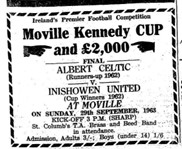
When the summer of 1964 swung round, there were 19 teams entered into the Kennedy Cup including the Carfin Emeralds and the first English side to take part, Manchester Athletic. In addition, Dublin Celtic travelled up from the Irish capital and no less than eight teams from Derry signed up. The £2,000 prize fund was now attracting international interest.
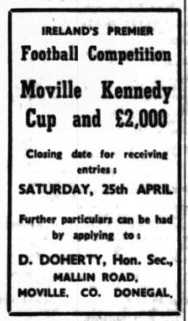
The Emeralds got off to a bumpy start again, drawing 1-1 with the Tonnage Dockers from Derry in the Kennedy Cup’s first round, which meant having to return the following weekend for a replay. When the team landed back in Scotland, they were met by reporters and the following day’s Daily Record ran the headline ‘RETURN OF THE PHANTOM FOOTBALLERS’:
With imitation beards and false noses tucked away in their travelling cases, Carfin Emeralds arrived home last night. The phantom footballers flew back to Renfrew after taking part in an Irish soccer tournament. As some of the team climbed into a minibus to return to the villages of Carfin and Newarthill, Lanarkshire, they were accompanied by 21 year-old John Dillon, former left-winger with Brighton and Sunderland. He said: ‘Me play with the team? I’ve never heard of it.’
The Record went on to claim that ‘mystery and intrigue surrounded the Emeralds two matches in Ireland.’ The reality was quite different – the team played a friendly on the Saturday before appearing in Moville the following day. The paper stated that the Emeralds were being managed by Tom McGinn who refused to name any of his players – because, he explained, they were missing their work to fly over to Ireland and back. No-one was swallowing that line and the press were happy to keep speculating as to which professionals belonging to Celtic and other clubs were really turning out for the ‘ghost team’.

The Emeralds despatched the Dockers with ease in the replay, running out comfortable 7-3 winners and prompting the Derry Journal headline ‘EMERALDS SPARKLED IN MOVILLE’. In the quarter final against the Derry team Rosemount, the Emeralds raced into a comfortable 3-0 lead by half-time with two goals from ‘Mochan’ and a brilliant effort from ‘Haughey.’ (These false names appeared in some match reports.) What should have been a second half canter turned into a rough trot as Rosemount pulled two goals back within 12 minutes of the restart. Once again the Emeralds were bedevilled by defensive uncertainty and unforced errors. According to the Donegal Democrat a ‘really ding-dong struggle’ ensued but ‘a gallant Scottish defence held out until full-time.’
In the semi-final the Emeralds faced Foyle Rovers and a ‘large crowd witnessed a very keen struggle between two good teams.’ A hard drive from ‘Mochan’ separated the sides at full time and, at last, Father Gillen’s phantoms had made it into a Kennedy Cup final. Waiting for them were the impressive Manchester Athletic. Ireland’s ‘Premier Football Competition’ marketed the game as an ‘international final’ with the Scottish and English teams meeting down at the Bay Field on Sunday 11th October – with the two sets of medals provided by sponsor Harp Lager.
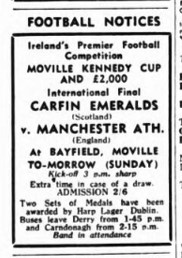
It was yet another record crowd in attendance with fans being brought in by bus from Derry and Carndonagh. The Moville parish priest, Father Gallagher, met the teams before kick-off and the Tannaherin Children’s Accordion Band provided the music. The Carfin Emeralds did not interfere with the photographers snapping away at them before and during the game and there was no repeat of the acrimony from 1962. Some of the players wore no disguises although most had false beards, side whiskers or make-up applied to their faces. As was standard, no team line was issued by the Emeralds.

The approach taken by the Scottish team to this final encounter was spot-on. They raced into a commanding lead, even though Manchester Athletic were no mugs (they told some of the Emeralds post-match that their team was largely drawn from the famous Bishop Auckland junior outfit from the north of England and some of their players were presently studying in Manchester). Fifteen minutes into the second half and the hooped phantoms were winning 4-2 when one and then another Manchester player was sent off in quick succession – the first (Sykes) for arguing with the referee and the second (Bull) for felling an Emerald who had to be carried off the field for treatment but was able to return after a few minutes. Playing now with only nine men, the Manchester side were doomed and the Emeralds added three more goals to take the Kennedy Cup with an impressive 7-3 scoreline.

The long-awaited arrival of the Kennedy Cup in Newarthill forms part of Howley family legend. Francie Howley had become good friends with Jinky following his exploits with the Emeralds and on one occasion he accompanied Francie to hospital to visit his brother Joe who had a broken leg. It was during that visit that Jinky reminded Joe of when they’d met before: the night the Kennedy Cup was brought back to the Howley home for the first time and Joe dropped it, accidentally breaking one of the handles! A repair had to be hurriedly arranged before the cup could be returned to Father Gillen at St Teresa’s.
THE MASKED MARVELS PREVAIL – AGAIN!
The story of the Carfin Emeralds did not end there. When Mr E.P. Hey of the North-West Regional Tourist Organisation visited Moville in late 1964, he heard encouraging reports from various local committees of increased tourist numbers in the area. Eamon Gillen, who chaired the meeting, reported how attendances at the Kennedy Cup had grown from a total of 10,000 in 1961 to 20,500 in 1964. The town and local businesses were benefitting from the widespread interest generated by the tournament and the exploits of the Carfin Emeralds in particular. In 1965 the total prize money would again be £2,000: Father Gillen rounded up the usual suspects.
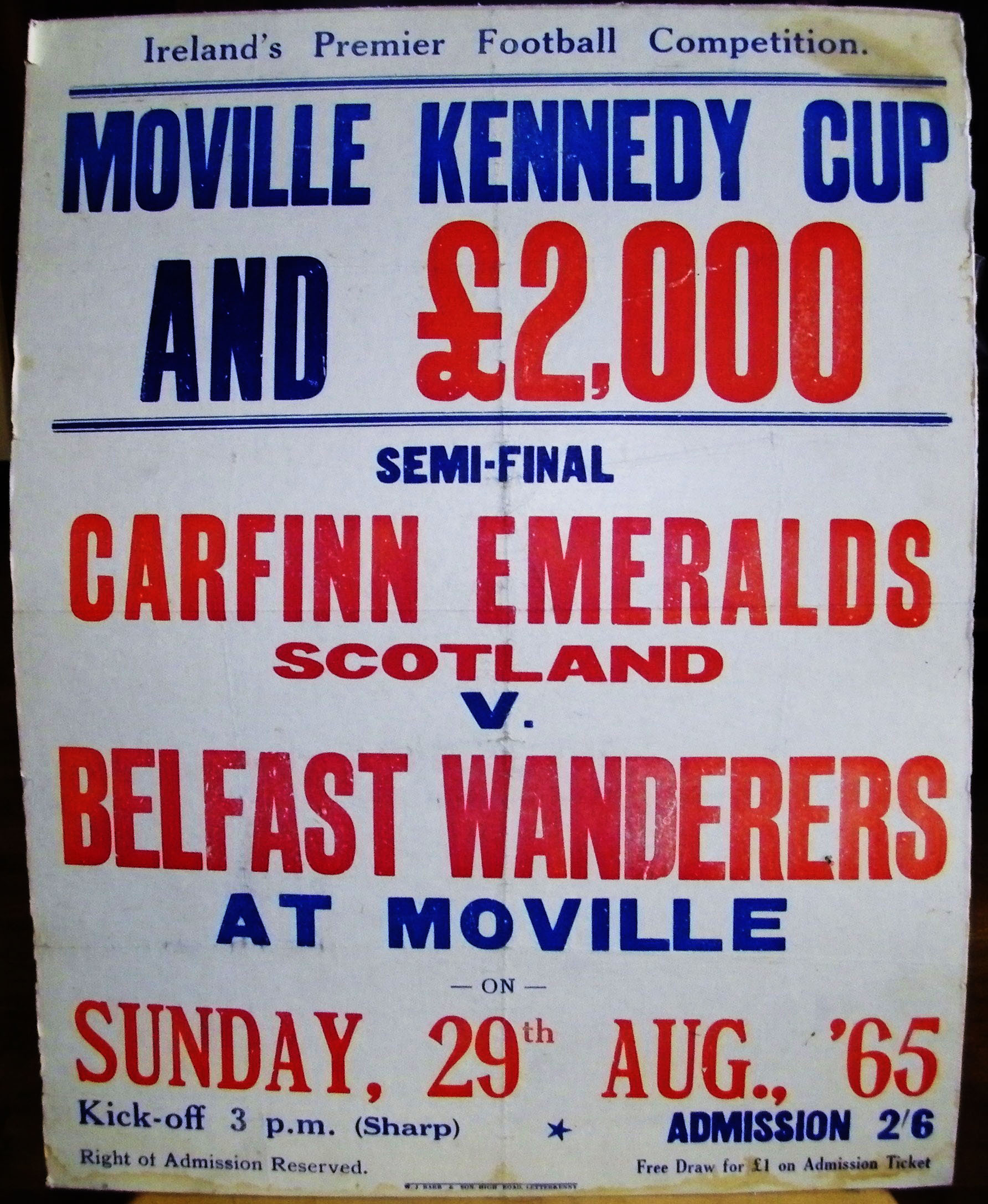
Kilmacrennan were knocked out in the first road and Bohemians of Derry met a similar fate in mid-August. On that occasion the Bay Field was entertained by more than one Carfin ensemble as the Robert Emmet Accordion Band, members of the Carfin Division of the Ancient Order of Hibernians, marched around the pitch at half-time playing the old songs of rebellion and occasional hymn to the Donegal crowd.
There was a delay in the semi-finals proceeding as the Bay Field had flooded due to heavy rain and high tides. Once the pitch was playable it was the turn of the Belfast Wanderers to fall to the Emeralds, setting up another final appearance. A Derry team provided the opposition this time: Village Celtic. In the build-up, the Donegal Democrat explained how the Emeralds had become the ‘glamour team’ of the competition in the previous four years ‘not alone for their outstanding football ability, but also for the mystery that surrounds their personnel’:
Reporters and photographers from the leading cross-channel daily newspapers have followed them in all their matches and also tried at the airports to discover their identity but without success. All they could do was give front page coverage to, as they named them, the ‘Masked Marvels’ as they played in masks and beards and hint that they included well-known Scottish international players.
Although the Emeralds were ‘undoubtedly a good footballing eleven and play the cup type of football needed to win this kind of competition’ the newspaper stated that Village Celtic would be ‘no pushover’ as their semi-final victory over the outstanding Derry Harps team had proven.
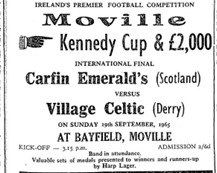
The Democrat’s assessment proved quite prophetic as Village Celtic were worthy opponents in the final. With a stiff wind at their backs in the first half, the Scottish team took the lead after 35 minutes when outside-right ‘Joe Williams’ raced on to a pass from the left and beat Frazer in the Celtic goal with a crisp shot.’ After the break it was Celtic who had the benefit of the wind and it looked as though the impressive McKinney had equalised only for the referee to blow for an infringement. The Carfin defence remained firm and a narrow 1-0 score-line was enough to ensure that the Kennedy Cup and bulk of the prize money would once again make their way to St Teresa’s Parish in Newarthill.
THE VERSATILE MONSIGNOR
That was to prove the high-water mark for the popularity of the summer cup era in Ireland’s north-west. Europe and further afield were proving more popular tourist destinations than Donegal, and the prize fund for the Kennedy Cup began to decline to £500 in 1967 and then £400 in 1971. Crucially, there would be no return appearance by the ‘ghost team’ from Carfin due to the drop in prize money and football clubs now increasingly sending their teams out on tour in the summer.

In the Kennedy Cup final of 1970 the Irish tricolour flew at half-mast to mark the sad passing of Eamon Gillen who had died suddenly while visiting his brother Father Jack in his new parish of East Kilbride. In 1983 Father Jack was made Vicar-General of the Diocese of Motherwell and given the title of Monsignor. On his retirement from the ministry in 1992 after a lengthy period in Rutherglen, he returned home to Moville and it was there he died, aged 79, in 1995.
In Bishop Devine’s homily, one characteristic was highlighted that set the Moville Monsignor apart:
If 1967 was the annus mirabilis for Jack’s beloved Celtic, 1947 was the annus mirabilis for the Joes of Glenboig. Yet they won nothing when they should have won everything in sight, due to a reinstated junior player being economical with the truth about his age, as reinstated juniors had to be under 26 before competing as juveniles. The Scottish Cup which they had won was taken from them and they were banned from competing in the Lanarkshire Cup final a few days later. Jack used to say it was as if every family in the village suffered from a bereavement in the same week.
Of course, being Jack, he found his own unique way of getting his own back on Scottish Football officialdom a few years later, with the splendid football tournaments staged in Moville’s Bay Field in the late 50s and early 60s, with professional footballers disguised under masks, wigs, and shoe polish, appearing for the Carfin Emeralds in competitions that he organised each summer. Versatility should have been his middle name.
Long after their demise, the Emeralds had the church’s stamp of approval. Their story was clearly known in some circles, but no-one who took part had ever spoken to the media about their capers in the Irish countryside. In recent years, as more and more newspapers from the era became available online, match reports and other press coverage of the summer cups appeared but the key details required to complete the story remained elusive.

In 2012 the Derry Journal mined its archive for some match information and photographs that had gone unseen for years (‘Soccer superstars in disguise in Moville’) and this formed the basis for a two-page piece in the football magazine When Saturday Comes the following year. These articles focused solely on the 1964 Kennedy Cup and contained inaccuracies. The claims that Jinky, Neilly Mochan and Frank Haffey had turned out for the Emeralds fuelled later exaggerated claims that most of the Lisbon Lions had turned out in disguise as Carfin Emeralds. The pieces of the story didn’t fit and significant gaps remained.
CROY CONNECTIONS
In March 2020 my Dad, now 75, wanted to visit his home village of Newarthill and the two homes he’d grown up in. We stopped off at St Teresa’s, now standing for exactly 60 years, and talked about the Emeralds and the story so far. Interest was rekindled.
On reviewing my notes, Pat Cassidy mentioned that a few of team-mates in the had come from the Croy area and a few had played for the local junior team Kilsyth Rangers. I had three names and searched online for details of them. On the Pie and Bovril Scottish football site I found mention by a Kilsyth Rangers historian of three of their players having taken part in the Carfin Emeralds’ escapades, two of them going on to win the Scottish Junior Cup in 1967. The players weren’t identified and I sent the historian a private message asking for more details. He hadn’t posted for a while so I made contact via the club’s Twitter feed, only to be advised that the historian had died the previous November.
All hope was not lost. I came across one of the player’s names in Richard Purden’s 2013 book on Celtic supporters Faithful Through and Through which included an interview with a group of fans from Croy. Could it be the same fella? Thanks to Matt McGlone of the Alternative View I made contact with Richard, and in no time at all he produced a telephone number for me to try. Could it be the same man? Would he still be alive seven years on from that interview? I made the call with a little trepidation, and was soon speaking to Tony Weldon – a Carfin Emerald from the first year of their existence to the last!
Over the course of that lengthy call and a socially-distanced meeting in the garden of his home in Banknock, near Kilsyth, the following day, Tony provided all the missing pieces of the Emeralds jigsaw. For someone on the cusp of turning 80, Tony’s memory and grasp of detail was something to marvel at. When Frank Brennan’s FA Cup successes with Newcastle were mentioned, Tony reeled off the name of every Newcastle player of the 1952 team who beat Arsenal in the final – and every Arsenal player for good measure too! This augured well for hopes of completing the Emeralds’ story.
Tony was football mad as a youth growing up in the Celtic-mad enclave of Croy and had been named after his uncle, also Tony Weldon, who had played for Everton, West Ham United, Hull City and Airdrieonians in the 1920s and ‘30s. By 1961 Tony had played junior football with Dunipace and Petershill. The closest he came to going professional was a trial with Falkirk but he was really only interested in getting picked up by Celtic. Earlier that summer, Tony had been recommended by the local boxing legend Bill Clinton – father of world fly-weight champion Pat – to Tom McGinn, Father Gillen’s assistant, who was the nominal team manager of the Emeralds. Tom and Bill worked together as bricklayers. Along with Tony, Bill Clinton had recommended Pat Waters and Tommy Reynolds who were both playing with Dumbarton at the time.
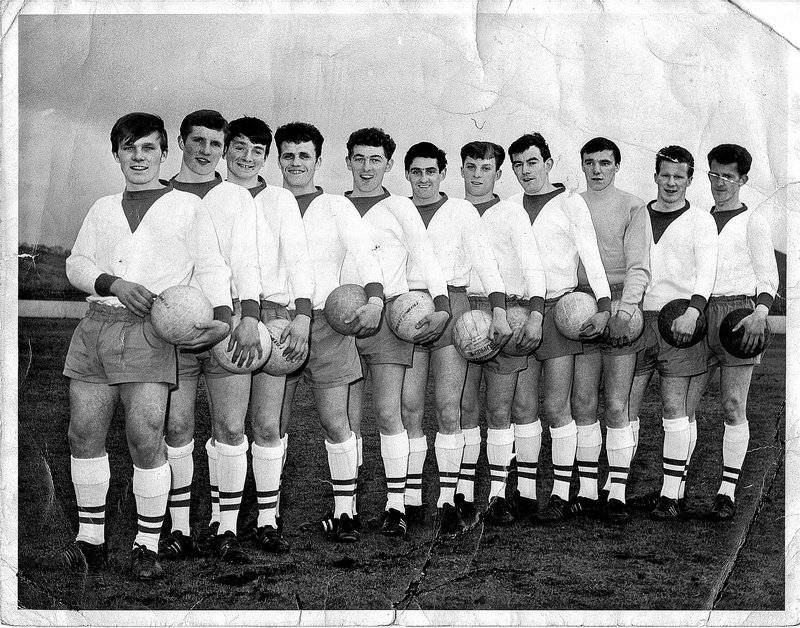
In addition to Father Gillen and Tom McGinn, Con McNeill and the brothers James and Hugh Daly formed the Emeralds’ ‘management team’ and they took care of everything for the players in both Scotland and Ireland. There was no money on offer to the volunteer phantoms but a holiday in Donegal would be provided free-of-charge and their expenses met. There were one or two professionals who were approached to join the Emeralds who turned the offer down when they realised there were no financial inducements involved.
The first trial was a 7-a-side game which took place on the pitch surrounded by Carfin dog track and it was there that Tony met the team captain, Francie Howley, for the first time. Two trial matches were then held in Croy and Tony recalls that his Emerald team-mates then were: Pat Kelly (Falkirk); Joe Reynolds (Crewe Alexandra); Francie Howley (Third Lanark); Connelly (Raith Rovers); Joe Kiernan (Sunderland); Pat Waters (Dumbarton); Dan McLindon (Dunfermline Athletic); Jimmy Johnstone (Viewpark Boys Guild); John Dillon (Sunderland); McGlinchey (Nottingham Forest).
Tony confirmed that the highest profile Carfin Emerald at their first outing to Donegal was Frank Brennan, considered a giant of British football in the 1950s. When Tony first met the ‘Rock of Tyneside’ in a changing room at the Omagh Showgrounds he thought at first that the old, balding fellow sitting next to him was the referee and not the Newcastle United legend. Frank had recently returned from a coaching gig in South Africa but his playing days were long behind him – as evidenced by him being responsible for shipping not one but two goals in the Emeralds’ colours.
SOLVING THE JINKY RIDDLE
When I asked Tony the all-important question – had Jimmy Johnstone played in both the Kennedy Cup and the Battisti Cup – he responded emphatically: ‘Jinky definitely played in both tournaments. I should know because I shared a bed with him!’
Although the accommodation in Moville was free it was not luxurious and, as two of the smaller players in the team, Tony and Jinky had to share a large double bed. Tony recalled that one night they returned to their room after a few drinks (Jimmy was not a big drinker at this time) to find a single mattress laid out in front of their bed with a man sound asleep on it – barring their way. It was only after Sleeping Beauty received a rude awakening that the two Emeralds could get into their own bed!
Tony cleared up one long-standing query about the Donegal affair. Jinky only played for one summer for the Emeralds – the team’s first year, 1961. He was 16 at the time and was not signed by Celtic until October that year then immediately farmed out to Blantyre Celtic. He made his Celtic first-team debut in March 1963.
Why would there have been any fuss made about Jinky in 1961, I asked? Tony explained that Jimmy’s name was already known throughout Lanarkshire and beyond as he was a legend in schools football and there was a huge buzz about him as ‘the next big thing.’ He played a few years ahead of the age group that he should have played with and had won a hatful of medals. The general view was it was only a matter of time before Celtic would snap him up although he had also come to the attention of Matt Busby at Old Trafford. Most importantly, even at 16, he was simply thrilling to watch with the ball at his feet, developing the jinking style that would earn him his unique nickname.
It had been agreed in advance that the players would play in disguise to avoid retribution from their clubs and the football authorities, however the goalie Pat Kelly did not want to wear a mask. Fortunately, the Emeralds had brought their own make-up artist – Christy McCrory – along with them! It was Christy who came up with the idea of using burnt cork to give Pat a ‘blackface’ complexion to stop the press from guessing who he was.
Tony explained that different jerseys were worn in the different tournaments: green and gold stripes in Omagh; barrel hoops in Moville. The crowds at the Saturday night games in Omagh were great and the reception that the Emeralds received there was equally impressive. Moville was their base throughout the years and the players often spent their downtime around Eamon Gillen’s hotel.
From the first year on, the Emeralds were subject to close media scrutiny. In the Donegal games there were TV crews and a gaggle of reporters present. One day newspapermen turned up at Tony’s home in Croy asking if he was one of the phantom players, which he denied. He allowed his photo to be taken, and when his Dad came in with the paper which included Tony’s photo the following day they realised that behind Tony was a table lamp which he’d brought back to his parents promoting the summer destination of Moville!

Most of the photographers who attended the Emeralds’ games were easy to deal with and some explained that it was never their intention to reveal their true identities as this would have meant there would be no story to publicise the following year. In the flashpoint that took place with the Belfast Telegraph lensman in 1962 it was Tony who lashed out at the snapper first as he had snuck around the back of the players to grab a photo of one Emerald without his mask on.
When the Emeralds struck success in the 1964 Kennedy Cup, Tony played at centre-half. The following year Tony missed both the semi-final and final through injury as the cup was retained. On his recommendation, John Donnachie and John Fitzsimmons – two team-mates from Kilsyth Rangers – were recruited. The two Johns followed up their medals from the 1965 Kennedy Cup with Scottish Junior Cup winners medals two years later when Kilsyth beat Rutherglen Glencairn 3-1 in the final at Hampden Park before a crowd of 11,500.
EMERALDS AND DIAMONDS
There were many Celtic connections among the Carfin Emeralds but the only bona fide Celtic player other than Jinky who donned a mask over the five years was Frank Meechan, a defender in the 1954 Double team alongside Jock Stein, Charlie Tully, Sean Fallon and Bobby Evans. Frank had retired from the game in 1959 and would later become a Celtic scout. He played for the Emeralds once, in a challenge match at Castledawson in June 1964 against Lansfield who were made up of players from both Irish Leagues. The Emeralds fielded six players who came from Croy in that game and recorded an impressive 3-1 victory. As well as Frank Meechan and Tony, there were the Morrison brothers (Tommy from Aberdeen and Willie from Portsmouth) along with Pat Waters and Tommy Reynolds.

Jimmy Mallan came from Johnstone Burgh and his father had played for Celtic in the early 50s before being ousted by Jock Stein (Stevie Mallan, the former Hibs player is his grandson). Joe Grant, cousin of Lisbon Lion John Clark, played one game for the Emeralds and later joined Birmingham City. Despite reports, neither Neilly Mochan or any of his footballing brothers played for Carfin and nor did Pat Crerand.
Other Emeralds included winger Ernie Hannigan who signed for Preston North End one day and was on a flight to Donegal the next without his new employer having a clue as to his whereabouts. Ernie went on to play for New York Cosmos. George McKenzie was recruited from Cambuslang Rangers and Tony Canning also came from the juniors.
Tony had red hair which gave him a passing resemblance to Jinky which he and the other Emeralds played up to in their dealings with the press. Pat Cassidy looked a little like Billy McNeill at the time and these similarities that helped feed the myth that the Emeralds were a team packed full of Celtic players.
There were some memorable opponents that the Carfin Emeralds came up against in the summer cups including the Crossan brothers, Johnny and Eddie, legends on the Derry football scene. Sometimes players would run out to play against the Emeralds that Tony recognised from previous encounters in the same tournament that Carfin had won! There is one opponent in particular that clearly stands out in Tony’s memory – the remarkable Jimmy Hasty. He was a striker from North Belfast who had scored goals freely for Dundalk and was part of the first ever Irish team to win a European Cup tie. Amazingly Jimmy Hasty achieved this with only one arm. Tony was his direct opponent in one game and he found Hasty difficult to beat in the air – as he was using his stump to dig into Tony and prevent him from jumping! Tony’s solution was to shout on his brother Matt who had been called into the Emeralds team who was taller and he was able to handle Hasty more comfortably. The sad postscript to this tale is that Jimmy Hasty was murdered in October 1974 on his way to work in Belfast in a sectarian attack by Loyalists.
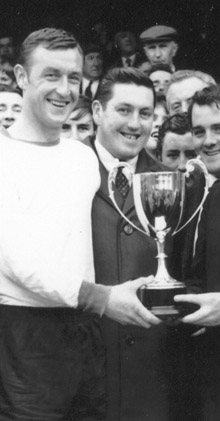
His years as a Carfin Emerald provided Tony Weldon with an array of great memories and stories which he loves to tell and are an absolute joy to hear. He had completed the circle for me: the story of the Emeralds could now be told in its entirety without any need for varnish or more guesswork. It remains a remarkable tale over 50 years later.

Tony remained in contact with Jinky through the rest of his life. He remembered the last time they spoke on the phone, about two months before Jimmy passed away in 2006 when he started singing at Tony down the line! They got up to some high jinks on their trips to Ireland and one story in particular stands out.
On a rest day in Moville, Jinky was desperate to go and visit some horses (he adored horses) and had been told there was a horse-riding school nearby. Tony and Francie Howley were cajoled into going with him in search of these horses. They found the school but were advised by the owner that it was closed that day. Tony, pointing at Jimmy, explained to the owner that he was a young lad with a terminal health condition, and it had always been an ambition of his to ride a horse. Suitably hoodwinked, the owner agreed to let the three amigos have the use of some horses and off they went, riding four miles up the coast to Greencastle where they stopped off for a welcome refreshment.
Jinky was a natural jockey unlike Tony who was coming down when his horse was going up and vice versa. When they finished their drinks in the pub they walked outside and Jinky was aghast to find that only two horses were still standing there – his had ran away! The truth was that while on a visit to the toilet, Tony had snuck out the front and moved Jinky’s horse around the back. He let the Wee Man sweat it out for a few minutes before revealing that his horse had not in fact bolted.

Part farce, part footballing extravaganza, the story of the Carfin Emeralds is one of the most remarkable in the history of our beautiful game. It was a joy to discover that the tale my father had told me so often proved to be true and that the answer to the question posed in the Ulster Herald obituary sent by Dessie years ago was undoubtedly ‘Yes!’ – the Wee Man did indeed play at the Omagh Showgrounds. The unravelled mystery of Father Gillen and his Phantom Footballers is a small yet wonderful part of the legend that surrounds Jinky, the greatest ever Celt.
POSTSCRIPT
Tony Weldon passed away in January 2021, just a few days after his 80th birthday. Without Tony’s help, this story would never have been completed. It was a pleasure to meet and spend time with Tony in 2020 – rarely have I met a greater football or Celtic enthusiast. There are few Carfin Emeralds now left to tell their tale.
Gerry Lynott lived to the grand old age of 93 until his death in June 2022 in hospital Letterkenny. As well as his role in organising various Kennedy Cup tourneys Gerry also was a long-time chairman of Moville Celtic and was known throughout the town and beyond from his position at Lynott’s Corner Shop, a role he filled for almost 80 years.
My father Peter passed away in July 2024, two months short of his 80th birthday, and he was the inspiration to find out if his teenage memories of stories of Jinky and Scottish footballers playing in masks and make-up in the north-west of Ireland in the 1960s were true or just a Lanarkshire fable.
This article first appeared in Issue 7 of The Shamrock magazine.
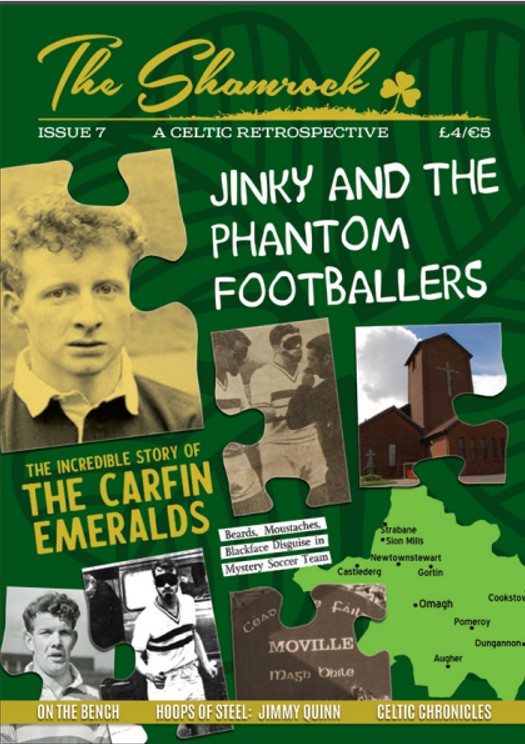
Back copies of this and other issues of The Shamrock available here: https://the-shamrock.net/magazine/
Get the Carfin Emeralds t-shirt!
Our t-shirt celebrating Jinky and the Phantom Footballers is available here:
https://www.redbubble.com/i/t-shirt/Carfin-Emeralds-by-Shamrocker/57835693.6ATOD

Shamrock Books – Know Your History
Enjoy our range of books on much-loved Celtic players, seasons, famous games, tournaments and supporter culture: https://the-shamrock.net/books/




 the shamrock