
‘THE HEADQUARTERS OF POPERY IN THIS CITY’
“The suburb of Bridgeton is an admirable illustration of this. Modern though it be, it has not been allowed to pass scatheless — the invaders having here also secured a refuge. A tenement of houses in Main Street was complained of as being ruinous, and in a state of disrepair; and it was remitted to competent tradesmen to inspect and report. The tenement in question is comparatively new, but, when we mention that it is known in the district by the name of the “Dublin Land,” it will be easily understood how it has become necessary for the Court to bestow upon it some share of its attention. Looking at this, and a hundred other instances of the pestiferous influence of these immigrants, we cannot help exclaiming—Repeal the Union.” – James Pagan – Glasgow Past and Present, 1851
James Pagan was a prominent journalist who became editor of the Glasgow Herald in 1856 and his views as espoused five years earlier on the impact of Irish immigration on Glasgow in the 1850s were shared by many in Scottish society at the time. Lazy portrayals of the Irish as dirty, feckless, criminally-minded and racially inferior were common in Victorian Scotland. Devine has argued that prominent Scots of the era including Thomas Carlyle, George Combe and Robert Knox supported a belief in “the absolute superiority of the Saxon and Teutonic stock of Lowland Scotland and England over the benighted Celts of Ireland and the Scottish Highlands. The thinking of the Teutonists lent a spurious intellectual legitimacy to anti-Irish racism of the time which was also given a special impetus by the arrival of the famine refugees.”
The immigrant Irish were frequently demonised in newspapers such as the North British Daily Mail and the Scottish Guardian. In a popular book published in 1848 and entitled Scotland for the Scotch by John Steill – a blood and soil Scottish nationalist who bequeathed almost his entire estate to build a statue to William Wallace in Aberdeen – he referred to the Irish as “invaders” and “clouds of the vilest specimens of the human animal in the face of the earth.” For ordinary Scots, association with these new immigrants would expose them to “Irish crime, Irish dirt, Irish disease and Irish degradation.” This kind of racist language remains in vogue with some politicians and commentators in Britian today but now directed at immigrants from Africa, Asia and the Middle East as opposed to the Emerald Isle.
In this poisonous atmosphere, the Irish settled in districts just a short walking distance from the Broomielaw quay. James Handley pointed out that the great mass of Glasgow’s population in the 1850s was “contained in an area of two miles in length by about a mile in breadth” stretching from Anderston in the west to the Calton in the east and north from Townhead to south in the Gorbals: “Into these two square miles were crushed no fewer than 300,000 of the 385,000 including within the municipal boundaries, a press of human beings more closely packed together than in any other city in Europe.”

The area just off the Clyde encompassing the Briggait, the Saltmarket, the Trongate, Glasgow Cross and up the High Street towards Glasgow Cathedral had quickly become known as the main Irish district in the city. In 1854, Glasgow’s Inspector of the Poor told a Government Select Committee of examples of over-crowding that he’d witnessed in “the notorious Jeffrey’s Close”, between the Briggait and Saltmarket. In one room measuring 12 by 14 feet he found 14 people living there. Another room, 12 feet square, was home to 23 men, women and children. The women mostly hawked fish and fruit on the city streets for a living while the men had found work as labourers, on Clydeside and serving masons.
In the absence of public housing at the time, the only affordable accommodation open to the Irish was sub-standard lodging houses. Dr James Russell, Glasgow’s first Medical Officer of Health, who would eventually persuade the city fathers to clear the slums around Glasgow Cross, once commented: “For years the population of many thousands has been added to Glasgow by immigrants without a single house being built to receive them.”
In 1843, Glasgow had 524 lodging houses in the city centre, with 240 of them squeezed into the area between Stockwell Street and Saltmarket which housed the city’s poorest who were entitled to some small relief from the local authorities, as Handley explained: “A very large proportion of those who were supported by the parish lived in those dens for a small monthly sum given direct by the parochial authorities to the lodging-house keeper who, in the interests of business, crammed as many as possible into her warren.”

As more and more Irish and others were squeezed into the already overcrowded lodging-houses, the appalling living conditions worsened as this medical inspector’s report from 1848-49 outlined:
Those frightful abodes of human wretchedness which lie along the High Street, Saltmarket and Bridgegate, and constitute the bulk of that district known as the ‘Wynds and Closes of Glasgow’ – it is in these localities that all sanitary evils exist in perfection. Those places consist of ranges of narrow closes, only some four or five feet in width, and of great length. The houses are so lofty that the direct light of the sky neve reaches a large proportion of the dwellings. The ordinary atmospheric ventilation is impossible . . . There is no drainage in these neighbourhoods, except in a few cases; and from the want of any means of flushing, the sewers, where they do exist, are extended cesspools polluting the air . . . The water supply is also very defective; such a thing as a household supply is unknown.
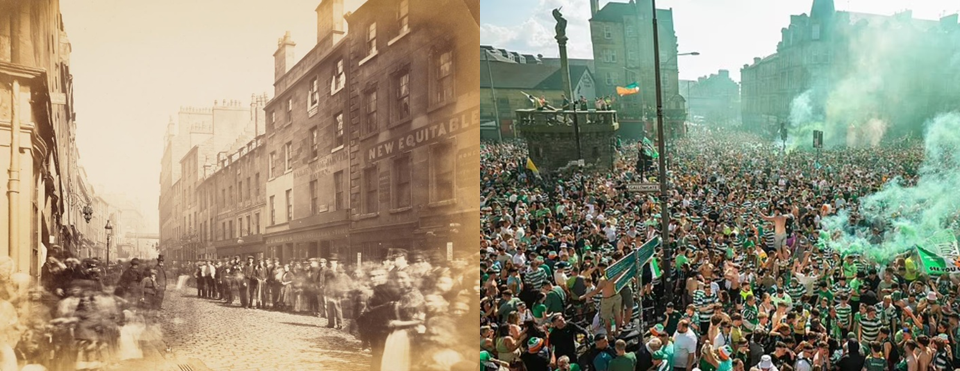
The area around Glasgow Cross at this time was undoubtedly perceived in the city as a largely Irish and Catholic district. In 1851 the Reverend Robert Buchanan, minister of the Tron Church of Scotland, referred to the neighbourhood his parish was in as “the headquarters of Popery in this city” in 1851.
It was not meant as a compliment.
‘MIDNIGHT SCENES AND SOCIAL PHOTOGRAPHS’
Life in the heart of Glasgow – 1857
In 1858 a book was published under the pseudonym ‘Shadow’ which gave a unique and remarkably detailed insight into what daily life was like for the tens of thousands of Irish who had made their home in Glasgow in the aftermath of The Great Hunger.

‘Shadow’ was a Glasgow printer called Alexander Brown who had been born in the city but lived for a lengthy period in England before returning home. He was dismayed at the widescale poverty he now witnessed in Glasgow and angered at the failure of city authorities to address the disgraceful social conditions. His ire appears to have been directed at those who were bent on portraying Glasgow as the ‘Second City of Empire’ while hiding the reality of the awfulness of life for most citizens. It has been suggested that he was prompted to write his sketches by a pompous claim made by the Glasgow Herald, bridling against criticisms of the living conditions of ordinary Glaswegians by The Times of London, that “these dark places of our city have been much improved over the last two or three years.” Brown knew, living in the city himself, that this was nonsense and that many thousands lived in filthy, insanitary conditions which put lives at risk, a fact the city fathers and their media cheerleaders preferred to ignore.
This forced Brown to decide, in 1857, to spend a week venturing out every day and night into the streets, homes, pubs, shebeens and brothels around Glasgow Cross and record the true nature of what life was like for the people living there. Beyond Brown’s aims of encouraging social reform in the city, his sketches captured a vibrant but often violent area with drunkenness and despair rife – yet occasional shafts of light did reach the gloomy backstreets and thousands of people who had taken refuge there.

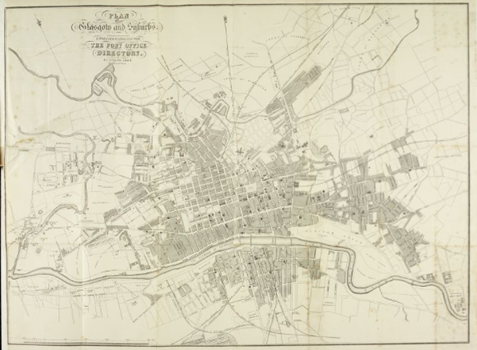
The focus of Brown’s investigations was the area around Glasgow Cross where five roads meet: the High Street, the Trongate, the Saltmarket and the major thoroughfares of the East End of the developing city – the Gallowgate and London Road (referred to as London Street the map below from 1854). In particular, he returned again and again to the buildings that sat in the area known as Sanitary District 14 – bounded by Saltmarket at the north, Stockwell Street to the west, Saltmarket to the east and the Briggait (Bridgegate) to the south. King Street still runs from north to south through this area but none of the notorious wynds survive. District 14 covered 35 acres, less than a hundredth of the city’s overall area in the 1850s, yet contained nearly half of Glasgow’s lodging houses. Dr. Russell, had condemned District 14 as “filthy beyond measure.”
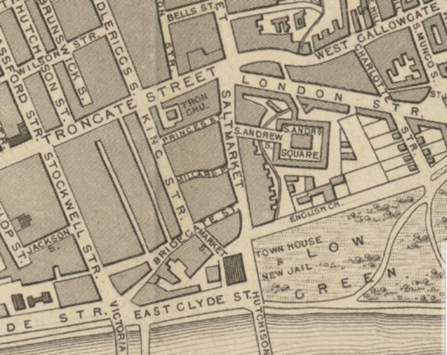
Brown’s account begins on a Sunday night, in the company of a Quaker. The Briggait is one of Glasgow’s oldest streets and home to regular raucous scenes. Describing it as “a Babel of noises – oaths, recriminations, and abuse” Brown notes that nearly every shop on both sides of the street winding leading to the River Clyde is a pub or inn. It was on this street he began to follow two policemen who were carrying a 14-year-old boy home on a stretcher after he had collapsed in the street. When they reach the room where his mother lives, the boy is placed in a corner “trembling with cold, writhing in pain with cramp, and prostrate by a weakening attach of diarrhoea. Some dirty rags, and remnants of clothes from anywhere, are collected, and thrown over him. The stench and closeness of the room are indescribable.”
This type of scene involving sick children was common in an age when there was no organised healthcare provision for the poor: “No-one knows where to get a medical attendant, or how to procure the means to purchase brandy or medicine . . . the whole neighbourhood had become more or less affected with attacks of a similar kind – viz. British Cholera.” Fortunately, Brown records, this boy survived the potentially lethal disease which is spread by contaminated water.
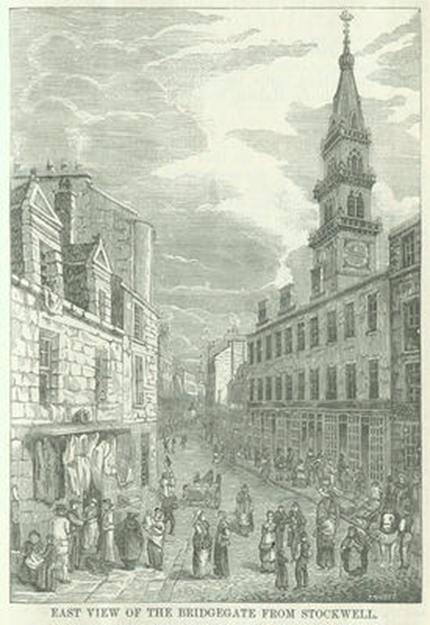
This first view of the ‘social volcano’ of the Briggait and surrounding streets is a resolutely grim one for Brown: “Rags, poverty, disease, and death are the appropriate emblems of the district.” Just off the Trongate, Brown and friend avail themselves of an illegal drinking establishment set up in a private house known to all by the Irish name of ‘shebeen’. Once the ‘landlord’ is satisfied they are not police officers, they are allowed into his home and “seated as if at a bar of an old-fashioned country inn, with a table before us and resting on a comfortable seat.” At the other end of the room “the busy housewife is neatly arranging the usual “set-out” at the bar – bottles, jugs and decanters – the latter temptingly exhibiting their golden coloured wines, brandies &c. Obvious, however, amidst all this is the absence of her Majesty’s stamped pewter pot or measure.” The shebeen is very much to the author’s liking even though it is not as cheap as he expected and the ‘landlord’ is happy to allow his clientele to get drunk on his unlicensed premises.
Near Argyle Street, Brown witnesses a woman asking passers-by for a “bawbee” (a half-penny) as she’d tasted nothing that day. She is forced to move away after being shouted off by a policeman threatening her with arrest – sadly one of many instances of harassment from officers of the law that Brown will witness over coming days. His sympathies are clear: “And so the poor creature, like a dog, is driven away into a side street, muttering as she goes words of just reproach against a world in which she has been alike neglected, wronged and punished.”
High Street after 10pm on Sunday evening, in the area where McChuill’s Bar sits today, was busy with “the locality still crowded with people . . . the victualler’s shop, the lollipop shop and the low pie shop.” There were no fish suppers or shwarmas among the late food available here. In one of the many nearby lodging houses, Brown approached the landlady and asked if any beggars were residing there. She responded: “there’s nane but respectable folk sleep wi’ me” yet looking into the room he noticed “a perfect pig stye, with three beds in it, all occupied by some poor traveller or outcast. The cost? “We can gi’e you a very nice clean bed for tippence; but it depends on whether you would ha’e onybody to sleep wi’ you or no.” When asked how many could be accommodated in these beds, she advised him sometimes nine but generally six or eight. When queried if this covered both sexes, the landlady responded: “Oh, aye, we’re no’ very partiklar.”
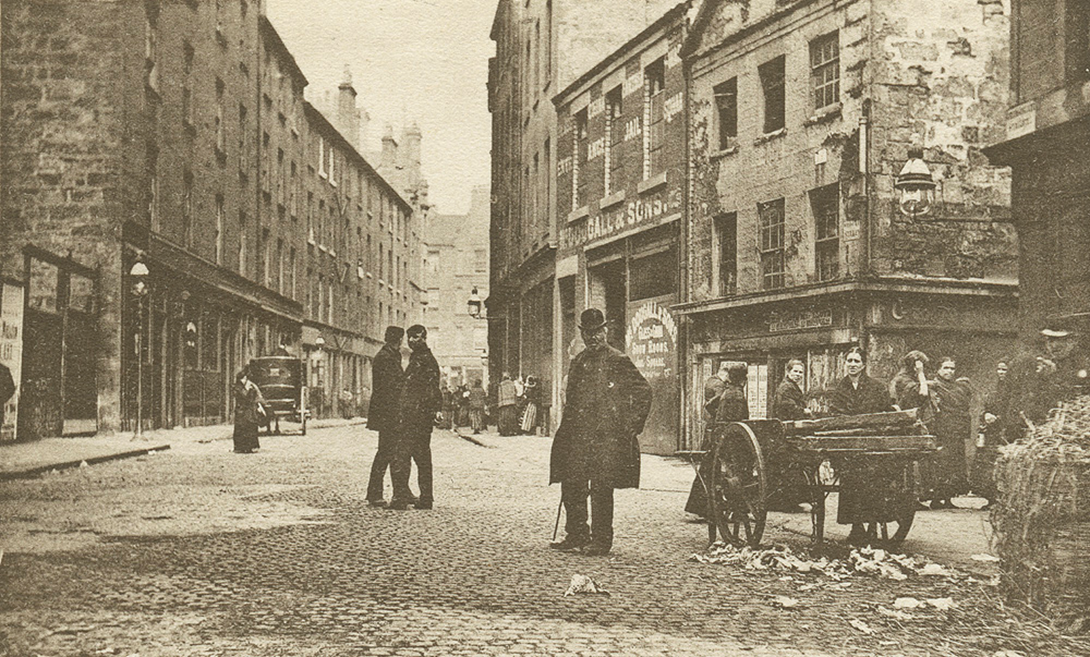
On Monday night, Brown wandered along Argyle Street where he was surprised at the throng of people, some of whom were very well-to-do. Asking a watchman the reason for the large crowd, he is advised “Big pay week, sir, big pay week.” The big attractions this Monday evening are the opening night of the Italian Opera and an appearance at nearby City Hall on Albion Street by Louis Kosuth, an exiled liberal Hungarian politician and journalist who was campaigning for Hungarian independence from Austria. He attracted a crowd of over three thousand in Glasgow that night and delighted them with a lecture on ‘The Organic Structure of Modern Europe’ which Brown enjoyed: “At one time the audience is soaring aloft with him on the wings of the highest philosophy; at another, they tenderly weep with him at the grave of Washington, or that of our own Robert Burns, both of which he has visited.”
Fresh from the political lecture, Brown was soon making his way towards the clamour of King Street where, sounding “as if hell were let loose” he wonders “about the madness and infatuation of the people.” His ears take a bashing from the cries of women selling apples, fish and all manner of goods and, despite being the first night of the working week, drink has already been taken in significant amounts: “Here, again the idiotical jeer and senseless laugh of drunkards, who now stand in groups, or stagger their uneven way across the street.” In addition, his ears are assailed by “the horrid oaths and imprecations of low prostitutes – carrying their loathsome figures about with offensive boldness – flushed with drink, and bloated with disease.” The cacophony of the sellers, the drunks and the whores (of whom Brown rarely has a kind word to say) leaves him yearning for the civilised assembly of the City Hall: “Under such horrid scenes the streets continue to groan, more or less, for many hours together.”
After the public houses had “vomited forth their unlucky victims” Brown visited the Central Police Station where a fight had broken out between inebriated sex workers who were “tearing, scratching and beating each other.” Each of the trio was taken to the cells for the night when, having their names taken, one revealed that her full name was Eliza Rosa Divinity, prompting one officer to retort: “you hae very little Divinity aboot you.” With the clock having struck “the melancholy hour of one” on Tuesday morning, Brown left the police station in the company of an ‘official’ and, just a few hundred yards away, they visited a shebeen “situated in a dark close, resembling a subterranean passage to some untraversed cavern.” In one of the rooms there Brown and the policeman came across “nearly half-a-dozen women, most of them in middle life … they are trying to appear calm and collected amid the excitement of obvious terror. They are poorly clad, pale, hungry looking, and emaciated.” However, there was no sight of ‘the bottle’ or any “vestiges of any kind by which the shebeen-keeper plies his nefarious calling” so the policeman moved on, ignoring the obvious.
Across the street there were several brothels and Brown and his companion gained access to one “with a little difficulty.” In a room of not more than 8 feet by 10, they found two recesses for beds in each of which were three “unfortunate” women with two others on the floor with a man, “apparently a protector – making nine persons in all sleeping in the apartment.” The inhabitants appeared to be asleep and were left alone.
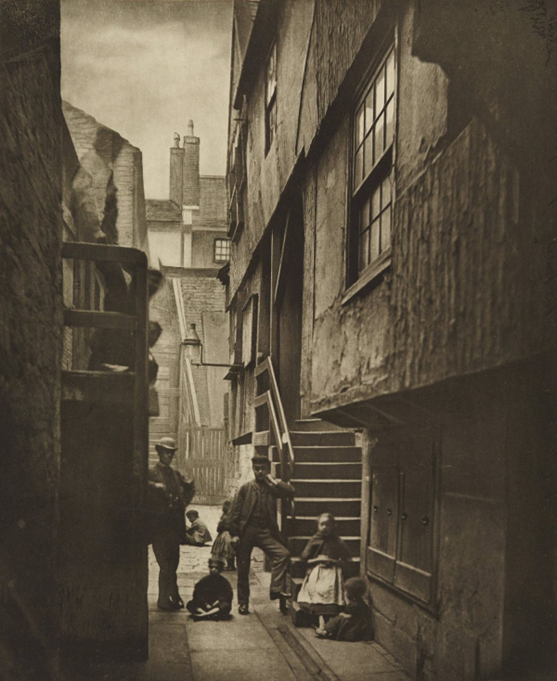
While “returning home by Bell Street somewhere about half-past two in the morning” Brown came across one of the most pitiful scenes he was to witness that week. Three outdoor sleepers were crouching on the doorstep of a grocer’s shop. Anticipating them to be “thieves and prostitutes” he engaged them in discussion. All three were girls and Brown calculated that the youngest of them was only 11 years old. When asked why they don’t go to bed, one of the older girls responded: “We have’na a bed to gang to.” They explained that the youngest did have a bed available but was afraid to go home to her mother, having been away since Saturday morning, for fear of a maternal battering. While they could have got a bed for the night for twopence each it was now too late and they had to lie on the stair through the night until morning. When asked what they did for work, one girl explained she sometimes sold herring which made her about three shillings a week. When asked what they made “by walking the streets” the response was: “Never more than three or four shillings a-week; and glad to get that.”
The following early evening, Tuesday, Brown returned to Glasgow Cross. He engaged a policeman in conversation who told him that he estimated that on Argyle Street, between the hours of eight and twelve, there would five or six hundred drunken people at least from one end of the street to the other. Some time earlier, the police officer commented, nearly 9000 people had been charged in a single year with being drunk and disorderly. When asked whether new legislation designed to restrict licensing hours would make a difference to these levels of public drunkenness, the officer replied: “No, not a bit; them that canna get drunk after eleven o’clock, get drunk a’ the faster before’t, but the maist o’ them hae their clubs, brothels, and hotels, whaur they get it, an’ then there’s nae preventin’ them.”
Brown came across a homeless woman who was begging for three more bawbees to help her pay for a room in lodgings for the night with up to half a dozen others. He asked her what she had been doing that day and she replied: “Jist lyin’ on the Green, sir, tryin’ to sleep awa’ hunger.” She hadn’t had a regular home for over two years and slept either on the stairs, on the street, or in the Police Office. She didn’t deny that she still drunk whisky when the chance arose but “folks like me are glad to get that, when they canna get anything else.” Leaving the woman, Brown ventured up and along St. Vincent Street to Blythswood Square, noting the “invidious contrast” between the comfortable occupants of the stately mansions living in still and peaceful solemnity amidst piles of architectural beauty and magnificence with the widespread squalor in which many thousands lived little over a mile away.
When his rambles took him back down towards Glasgow Cross, Brown came across a remarkable scene when a woman ran out of a close in the High Street “making the air to tremble with wild cries and shrieks for the police.” As a crowd quickly formed around the terrified woman wearing only a night dress to cover her nakedness and a baby at her breast, she explained that her husband was intent on murdering her. With police arriving on the scene, the husband himself made an appearance. He was angry and claimed he had justification for attacking his wife, having given her a fortnight’s pay at 6pm that night and returned home at midnight to find that she had spent all of it on alcohol, without having bought any groceries or other supplies for the next two weeks. The matter was left to the police to resolve. Brown wrote that from inquiries subsequently made, the claims made by husband – “an Irishman, a scavenger, and for his craft looked well-to-do and respectable” – were well-founded.
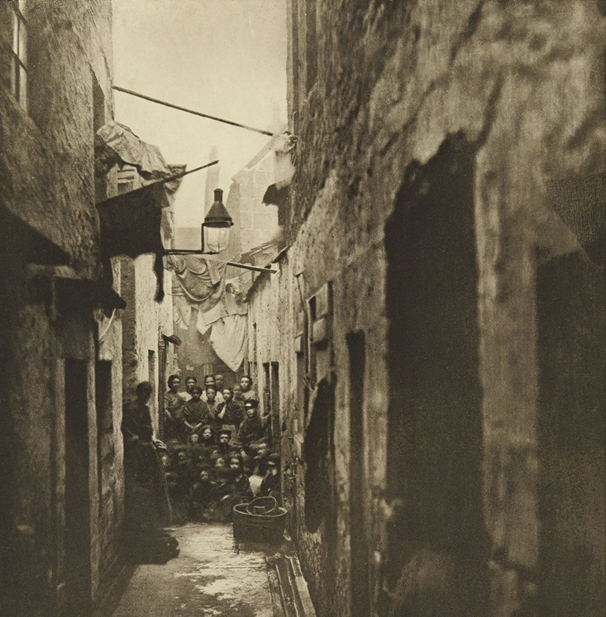
Wednesday was Market Day in Glasgow in the mid-1800s. Visitors to the city came to transact business at the Corn Exchange and many would “join the after-gathering at Stockwell where … a hundred or more shrewd, well-dressed respectable looking yeomen, driving, as best could, a hard bargain.” Brown was also aware of “another phase of city life” on Market Day where the focus was on a different kind of business transaction:
As if beating round a circle, whole armies of poor women, lost and abandoned, have turned out, contrary to general custom, in the blaze of sunlight, to prosecute their pitiable call. As they pass, flaunting in silk and satins – the vulgar blotches of rouge in the place of the once glowing health of beauty of the face, attract frequent attention. Thus these poor creatures, from their desperate condition, prowl like vultures after their prey. Anon we read of direful robberies and midnight assassinations – of Johnny Raw, eased of 75 guineas or poor Tom Flat, robbed of his gold watch and appendages.
That evening, Brown ventured along Clydeside, passing past the Suspension Bridge (a farthing one way, a bawbee to return), along to Broomielaw and the granite Glasgow Bridge. He captured the Clyde in all its glory: “The rows of gas lamps on either side, eastward and westward, reflects with picturesque effect upon the river, whose bosom, with over-varying trembling motion and ripple, presents the peculiar appearance of a sheet of fiery serpents – moving and turning playful gambol. The view is particularly beautiful, bearing comparison with London on the Thames, Paris on the Seine, or almost any other river-intersected city in Europe or the world . . . The long row of ships on either side are quietly moored in harbour; nothing but the occasionally gilded figure head of some noble vessel, and a dense forest of lofty masts, are to be seen for almost a mile. What a fine thing it is to see the ships of all nations collected here.”
A brief wander followed through the city’s south side, along Bridge Street and Eglinton Street (noting “the purer air of this more healthy vicinage”) before returning via the Gorbals over Hutcheson Bridge to the Saltmarket, back to the noise and the bustle and the hustle:
Hawkers of every persuasion still ply their uncertain and ill-required callings. Here Irishmen and Irishwomen innumerable line the streets with barrowfuls of fruit, bawling at the height of their voices – “Ripe apples! A-penny-a-pound! A-penny-a-pound!” There, squatted upon the wet pavement are a few junior venturers, with a basket of fish before them, dirty and handled by a score or more of previous purchasers – the dealer not believing in “stinking fish” is bawling lustily “Caller herrin’! Caller herrin’! Caller herrin’! Three a penny! Three a penny!”
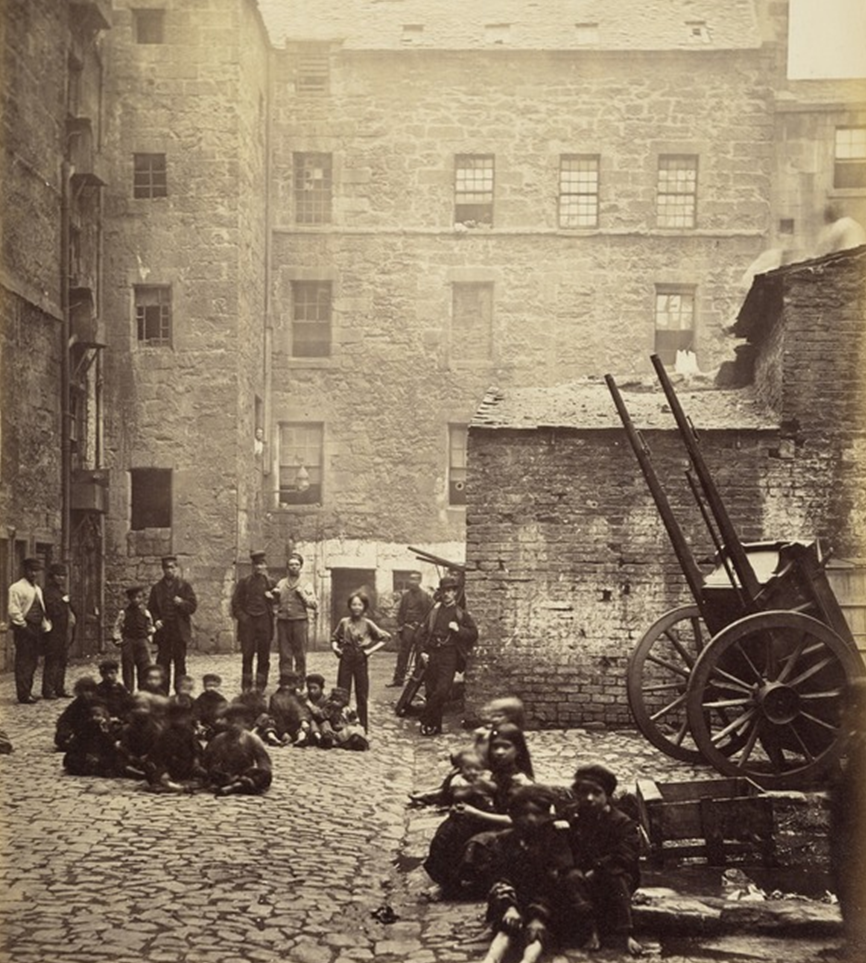
Outside the courthouse on the Saltmarket (opened in 1814 and still standing today) Brown came across a commotion as the Bridewell Coach made a stop outside the main court door on its way to the jail: “where numbers of thieves and prostitutes are waiting about – some in mirth and some in tears – for the arrival of their less fortunate companions in trade.” The appearance of the new inmates being taken onto the coach was “the signal for general uproar and exchange of salutation. The price of vice seems to sit supreme upon every criminal heart, as with jaunty air they proceed towards the vehicle amid all but universal acclamation. “Keep up your heart, Jim!” cry many voices, “you’ll soon be oot!”
Walking up the Saltmarket to Glasgow Cross, Brown has the “curiosity to look in upon the hovels of certain of the poor.” Approaching one “plain but respectable-looking man” he was granted access to the man’s dwelling house. The man told Brown: “There’s some queer places here, if you only saw them, but puir folks are glad to put their heads anywhere.” Shown round by the man’s wife Nelly, Brown noted that they had two rooms and in one there was a group of half-dressed people of both sexes collected around a fireplace. Brown estimated that between 6 and 8 people resided in the two rooms which he described as a wretched hovel, small, ill-lit and poorly ventilated. The only sanitation was a large filthy pail. Nellly told him: “We’re nae waur than our neighbours, an we dinnae think anything aboot it.”
Back on the Trongate after 11pm on this Wednesday night, Brown witnessed a web of vice in which the people appeared to have no means of escape: “Women of all grades of abandoned condition are alert after their prey. Virtue is now forbidden in the streets, or endangered by insult and molestation. Drink, in many cases, has got possession of reason, and the moral dignity of the man is submerged in that of the bestiality of the brute.”
His eye was caught by the sight of a “respectable-looking young man, apparently inebriated” who was “waylaid by one of these poor wretches of women.” Brown followed them towards the Gallowgate through “a series of low windings and narrow filthy streets, when they reach an open sort of court, fearfully dirty, apparently the place of rendezvous for the night.” It was a brothel and Brown followed the couple into two small rooms with earthen floors. One of the rooms had three beds: “In each bed are two loathesome women, covered by a few thick dirty bed-clothes.” Brown took the opportunity to question the women. Asking one girl “How do you like to live here?” she responded: “Like – I like it fine but likin’ has naething to dae wi’t – we’re obleeged to like it.”
Whisky was passed around “in an ill-used egg cup.” One of the women commented that she had been poisoned previously by drinking this unlicensed whisky. Brown was surprised when a “short thick-set blackguard-looking fellow leaps out of one of the beds. “The Protector” we say.” Having seen enough, our intrepid narrator decides to leave – only to find the brothel door locked. “A trifle of money to the door-keeper, who remonstrates against our leaving, and we forthwith take our departure from a very dangerous den of the worst of thieves and prostitutes.” Market Day in Glasgow had come to an impromptu end.

The following evening, we find Brown rambling around Glasgow Green, “one of Glasgow’s most valued inheritances.” From Nelson’s Obelisk to the Suspension Bridge and the Humane Society House, Brown extols the virtues of “this spacious and picturesque retreat” and is again enchanted by a Clydeside view: “The noble winding river, with its fine bridges, and dazzling lights, is enchantingly beautiful. The city itself seems like a great, stary constellation, occasional luminaries disappearing from the view like so many meteors from the higher heavens.”
Over towards the courthouse on the Saltmarket he describes various rival book auctions going on which attracted a sizeable crowd resulting in the sale of “many editions of Pilgrim’s Progress, Aristotle and Josephus.” Crossing the Green he came across an unlicensed establishment called Parry’s Theatre which charged a penny for entrance. Inside Brown estimated that there was an audience of two or three hundred people “many of them respectable factory lads and lasses, but some of them of the lowest dregs of society, their ages varying from twelve to twenty.” The venue was not to Brown’s liking (“As the curtain drops, so does decorum”) and he decided to leave, turning onto the Saltmarket where he came across a rival establishment, the Jupiter Temperance Hall. “Come to the Jupiter! The best company in Glasgow!” announces the posters and that is enough to persuade him to part with thruppence to join an audience of a hundred. The highlight of the performance is an English woman who “with beauty and song, enraptures the audience”, receiving vociferous requests for encores at the show’s close.
Brown then decided to “take a run through more fashionable houses of the kind in the immediate neighbourhood.” These places are “frequented by the mechanic, clerk, or shop-keeper” and “the singing, music, and dancing in these establishments are esteemed respectable.” Yet the demon drink is again prevalent much to Brown’s distaste: “That recreations innocent in themselves, should be thus degraded by the constant association of a popular vice, is deeply to be regretted.”
Returning to the streets of Glasgow Cross around eleven o’clock, Brown notes that Thursday night is significantly quieter than the rest of the week. He was by no means alone though: “If drunkenness and riot, however, are less prevalent on the streets, not so is it with vagrancy and prostitution. As bread gets scarce, these sorry victims hang about the lanes and thoroughfares of the city far into midnight.”
Brown comes across a familiar face: “A poor respectable-looking girl, whom we have often before met, now approaches us. She is without her companion, a short thick-set looking woman – older in years and in vice than herself.” When asking about her friend’s whereabouts, Brown is shocked by the girl’s response: “She is dead!” Inflammation was the cause of the woman’s death. She was cared for by her sisters “from a distinguished family” in her last days but nothing could be done to save her. One consequence of the woman’s death was that her young companion was now wandering the streets and wynds of the city alone late into the night.

On Friday, Brown extended his perambulations through the city streets. Starting on Stockwell Street, home to many of the pawn shops in the neighbourhood, he headed out to the manufacturing district of Bridgeton in the East End. There, despite an “inordinate number of public-houses” he found the working population to be of “quiet, sober and respectable demeanour.” Speaking to one girl employed in a local mill he found out that nearly all of the workforce there were working half-time due to reduced workloads. Of greater concern was the re-appearance of soup kitchens, a sure indication that an economic depression was developing: “…through dearth of work and high-priced provisions, bread and soup are already being distributed amongst the unemployed in this neighbourhood.”
Returning to the city centre, Brown encountered a scene of pitiful drunkenness. Two policemen were holding up a drunken woman while her child, a boy of 7 or 8 “clings to her with tears in his eyes.” When the police threaten to take her to the station as she refuses to head for home, the boy “makes his little bare feet to dance on the cold, wet pavement, exclaiming “O dinna tak’ her up! Tak’ her hame! Come mither, come hame!’ After being “touched with a natural sympathy”, the policemen decided to leave the woman home instead.
Around one in the morning, our narrator is back on the Saltmarket and is permitted to join two policemen as the wander through the wynds leading from the main road, visiting various rooms and brothels. While the streets are generally quiet, the buildings are not. Noting that the New Vennel, at the top of High Street, is home to a “hundred dens of infamy”, Brown reports that the same dens can be found in the wynds of the Trongate, Argyle Street, the Gallowgate, the Calton and the Gorbals: “Riot, drunkenness, theft, and profligacy of every kind – it may be murder itself – are the pastimes which they are engaged, and all on this very quiet day of the week, Friday!”
Saturday at last and “a week of toil has all but ended” proclaims Brown. In the afternoon the half-day excursionists are out in force taking advantage of the early finish: “The merchant has deserted his counting-house, and the mechanic his workshop; the former to join his family in some marine retreat; the latter, with not less happiness, to enjoy a short sail on the Clyde, a trip on the railway, a game on the Green, or in such other way as fancy prompts.”
As darkness descends in the evening, “Everybody seems to have turned out to look at everybody, and to do business with everybody.” All are “as busy as bees” and all are out: “The din of the streets by this time has reached its climax, – dense masses of moving columns block up every thoroughfare, and vendors innumerable line the margin of the causeway, offering their wares at incredibly low prices. Yet nowhere is as busy as the pubs. “The Public House, next to the house of God by far the most important institution in the city, if we may judge from the encouragement it receives, is now reaping a ‘delightful harvest!’ Glasgow’s fondness for drink was already well-established at this time and far beyond the city’s boundaries. Brown makes reference to “Mr Kohl, the German traveller” who had previously referred to Glasgow as “the most religious and the most drunken city in Europe or the world.”
At the King Street Market, in the heart of District 14, “Saturday’s evening carnival is only just at its height. As the public houses close, the homes of the poor get filled.” After husbands – drunken or overworked – have returned home and produced their “weekly pittance” it is the time when “the hungry, ill-conditioned housewives venture out to make their purchases.” Noise and turmoil is all around. Everything it seems is on sale. Cabbage, cauliflower, cheese, crockery, hard and soft ware of every kind is up for grabs from “various vendors with an energy and strength of lung truly astonishing.” Children form part of the sales throng: “we are saluted by a whole string of poor dirty little girls, bare-headed and bare-footed, and dressed in all manner of ragged and musty looking garments, desirous of selling us a bowl-and-a-half of onions for a bawbee!’”
Goods are on sale in side streets throughout the district in “what seems to be a continuation of ‘Paddy’s Market’ or ‘Rag Fair.’” This is a Glasgow teeming with life. In a victualler’s shop there is an act of kindness witnessed by Brown. A woman is carrying twins, only a few weeks old, and two other women enquire about the children’s health: “Puir woman!” says one woman. “An’ the wee lambs!” remarks the other. The mother has “six other children at home, all but destitute” – the father, a labourer, has been suffering from serious illness for some weeks and is in the infirmary. One of the women “drops into the hand of the mother a copper coin and departs – perhaps the last she has got in the blessed world – for these poor people have warm sympathising hearts.”
It is now almost midnight when Brown watches two policemen emerge from one of the wynds “driving a long, narrow wheelbarrow” which contains a man and a woman. “Uncertain, indeed, whether they are dead or alive” Brown follows them to the Central Police Office where on this Saturday night “a babel of noise fills the room, better representing a den of devils than a house of correction.” The pair are husband and wife and it turns out they were drunk and not as feared dead: “the pair are seized by the heels, and the head and shoulders, dragging along the floor of the office, they are placed for the night in their respective cells.”

Continuing along the Trongate and to the top of the Gallowgate, close to the High Street, Brown stumbles across a riotous scene where two policemen and a drunken, middle-aged woman are surrounded by “some thirty or forty street prowlers, inebriate men and low prostitutes.” The officers pull the woman free from the grasp of the group and, as she made her way up a nearby close, one of them pushed her violently while threatening to knock her brains out – “an inhumanity which almost provokes us to revolt.” Brown is moved to comment on the disparity of treatment meted out to rich and poor in these situations: “The poor, because of their necessities, publish their sins in the streets, while their richer neighbours, often times not less vicious, though less odious, are able to screen their iniquities from the world!”
It is now early Sunday morning and, back along the Trongate, a boy is seen selling matches on the street – a “poor bare-headed, barefooted boy” who implores Brown and other passers-by to “buy a bawbwee worth o’ matches.” His name is Johnny and he is aged either 7 or 8. His father died due to smallpox and when asked how his mother is supported, the boy responded: ““By us gaun oot.” He explains that his big brother sells papers while a sister sells sticks to help this family of five who live in a single room survive. Collectively the children bring in about 3 shillings a week from their street selling while their mother receives two shillings a month from the parish or “toon-hoose.” It is clear from Brown’s writing that it is by no means uncommon for children as young as this to be out alone on the streets surrounding Glasgow Cross selling late into the night to make money for their families. No-one, including the police, takes any steps to prevent this.
With 2am having approached and gone, Brown is wandering around the Bush and Tontine Closes off the Trongate. Old, dilapidated apartments occupy the upper floors: “Each ‘flat’ or storey is, in many cases, let by the proprietor to some neighbouring tenant: it may be a publican or a pawnbroker, who again lets out the apartments in single or double rooms, to some old brothel-keeper or harbourer of thieves.” The Tontine Close is reputed the most dangerous of any in the city and our narrator cannot help but notice that “Nearly every stone of the narrow pavement on which we tread is stained with blood, and the black walls on the either side of us silent witnesses to unrecorded crime.”
Gaining access to various rooms on the upper levels, he records a by now familiar sight: “here groups of wild-looking creatures are collected about the hearth, or stretched in fours and sixes upon the floor, some pale, thin and emaciated, others fat, bloated and corrupt with drink and disease, all huddled together in the same small apartment.” At the top of one close he meets a middle-aged woman living alone with her two infants. She explains that she has twice banished her husband and now earns her livelihood by renting out a neighbouring room or, in Brown’s words, “harbouring thieves and prostitutes.”
In a tenement next door Brown comes across a series of deserted rooms before finding one occupied by an elderly couple in an obvious state of destitution: “They are lying upon the floor, covered by a few old rages of carpet or matting. From the narrowness of the room, their feet almost touch the fireplace . . . all over the floor are bricks and stones, and pieces of broken lath and plaster.” On leaving, Brown tries to close the door behind him when he is told “never to fash, for there’s naething to steal” – a sentiment in which we painfully concur.”
It was with those visits to the Tontine Close that Brown brought an end to his ‘Week of Nights in the Streets, Wynds and Dens of the City.’ While reviewing his experience of wandering around Glasgow Cross and its environs he went on to identify five “social evils”:
- Intemperance
- The Closes and Wynds
- The Irish in Glasgow
- Prostitution
- Neglect of religious and educational means
Brown states that he does not belong to “the class who would attribute all the vice and demoralization to the poor Irish, who have in numerous cases found in this city a convenient asylum from the greater want and beggary of their own country.” He identifies two sources for the extreme poverty he witnessed: “the British legislature, as well as the British people, have themselves to blame.” While Glasgow’s population had doubled in less than two decades prior to 1836 he did not consider this a symptom of health but something “caused by a continuance of that flow of immigrants, set in from Ireland and the Highlands, through the cool neglect of both peoples by the British Government.”
With the population of Glasgow in 1857 estimated to be 391,400, Brown comments that “we are assured that considerably more than one-fourth are Irish Roman Catholics.” Yet the influx of Irish into the burgeoning city was not of their own choice “for well we know that no love of wondering has brought them to our shores.” In the recent aftermath of An Gorta Mór in Ireland and subsequent impact on his native city, this Glaswegian was in no doubt what had happened and why:
We have said this much about Ireland: a large amount of the social destitution of this city, as well as that of many others in England and Scotland, is to be attributed to the legislative neglect of that country . . . Their numbers here are evidence of the persecution they have suffered; and the ignorance and destitution of their less fortunate countryman, proof of the educational neglect that they have endured.
Education was key to improving the poor prospects and grim social circumstances facing the large Irish community in Glasgow in the mid-nineteenth century – but ensuring their survival was the immediate priority.
NETWORKS OF MUTUALITY
It was clear that the Glasgow Irish had to primarily rely on themselves, in the absence of state and local government support, to nourish, stabilise and develop their community. Two elements would prove essential in binding the Irish into a viable community in the sprawling city by the Clyde: faith and nationality.
The Catholic Church had to re-organise to meet the needs of the expanding Catholic community in the city. The Church’s focal point in the city had long been the Cathedral parish of St Andrew’s on Clyde Street. The second Catholic church in the city, St Mary’s in the Calton, was only opened in 1842 (with sittings for 1,500 parishioners). By the end of 1850, the number of parishes in the city boundaries had grown to eight. The church-building programme gathered pace in the 1850s and 1860s and reflected the physical move of many Glaswegians out of the city centre, large parts of which were re-developed with the coming of the railways (including the area around Glasgow Cross) to the East End and north of the city.
The aim was not just to create buildings but to build new parishes in areas beyond the city centre, establishing formal Irish Catholic communities in every area where there was a significant population. Within those new parishes there would develop various lay organisations, organised under the auspices of the Church, which academic Terence Bride has identified as being of great importance “in binding together some Irishmen on the basis of a common catholicism in ‘networks of mutuality.’”
With the parishes came schools – and a parochial system of education which would address the fact that fewer than a third of Catholic children in the city were attending school in the 1860s largely because their families relied on their earnings from employment of various kinds to survive.
Education was critical to the development of the Irish community in Glasgow. Catholic schools were not funded by the state at this time. The economic burden of providing a Catholic education and supplying the teachers fell solely on the Church and parishioners. The key initial difficulty was a lack of qualified teachers and the Church in Glasgow turned to various religious orders for support – the Sisters of Mercy and Franciscan Nuns for the girls and the Marist Brothers for the boys’ schools. It was in 1858 that the French teaching order was invited to Glasgow and the first Marist school in the city was St. Mungo’s. Within five years the Marists were responsible for running St Alphonsus and St Mary’s schools also. Slowly but surely more schools and teachers were being provided to help educate the thousands of children of Irish parents now resident in Glasgow.
Many Irish continued to migrate to Glasgow following The Great Hunger. In 1855, two 15 year-old boys arrived unaccompanied in the city on a coal boat from Sligo on the west coast of Ireland. The friends, Andrew Kerins and Bart McGettrick, came from the town of Ballymote in County Sligo in search of work. It is believed they found somewhere to live and work in the north of Glasgow, in St Mungo’s parish covering Garngad Hill and Townhead, close to the nascent railway industry beginning to dominate the Springburn area.
Little detail is known of the early years of both boys in the city although it is understood that Kerins attended evening classes for adults run by the Marists at St Mungo’s School to improve his education. That connection was the impetus for him to decide to take religious orders and become a Marist Brother himself in 1864 at the age of 24. After a year of training at the Marist headquarters in France, he returned to teach at St Mungo’s before moving on to St Mary’s. In 1873 he became the first headmaster of Sacred Heart school in a new parish in nearby Bridgeton. By that point he had been known for almost a decade by his formal religious title of Brother Walfrid.
In 1848, as the full impact of the arrival of the Irish was being felt in Glasgow, Bishop Murdoch introduced the Society of St. Vincent de Paul (SSVP) into St. Andrew’s Parish. Local branches, known in individual parishes as conferences, sprang up throughout the city – 14 within the first decade compromising 31 Brothers (members). Their focus was to provide direct support through charitable acts to those most in need in their parishes. The Catholic historian, Bernard Aspinwall, described how the SSVP operated:
[It] met the immediate needs of the local poor Catholics: like a political machine it provided a safety net. Decentralised and local its primary concern was moral regeneration of the group. With its main emphasis upon stability and compassionate community support from cradle to grave, it merely reproached the existing order. At the same time, by sustaining the group within the normative values of the church, the S.V.P. strengthened ‘traditional’ family networks of support and service. As a recent study has shown, Irish immigrants had few state bureaucratic supports. The S.V.P. gave vital personal aid at critical times: birth, illness, education, unemployment and bereavement.
Visits to the homes of the poor and needy to assess what support was required was the most common activity of SSVP members. Money, food, clothing and other necessities were provided from Conference funds. Often local Conferences would provide direct financial support to schools. In March 1870, the Marist headteacher of St Mungo’s School, Brother Procope, recorded that the ongoing support of the SSVP in covering school fees which families were required to pay meant that the poorest children in the parish were able to attend the school.

Aspinwall refers to the SSVP as “a microcosm of a social welfare state” and the Society played a definitive role at a local level in alleviating the impact that poverty had on families in individual parishes. Hugh Darroch, born in Glasgow in 1859 to parents from County Antrim knew poverty from an early age. His father, also Hugh, was a miner who died when his son was aged only 2. Growing up in St. Mary’s Parish, the younger Darroch was an active member of the Society as an adult likely providing the kind of support which had been given to his family when they needed it most.
In 1887, in nearby Rutherglen, the first Secretary of the new St Columbkille’s Conference of the Society was a local lawyer, Joseph Shaughnessy. Born in Bridgeton in 1850 to Irish parents John and Mary Shaughnessy, he had been taught by both the Marists and the Jesuits in the city. His father was also able to send three of Joseph’s brothers to Blair College in Aberdeen from profits made from his business as a spirits dealer in Rutherglen. Joseph qualified in law from Glasgow University and was soon running his own firm, becoming the agent for the Scottish Miners’ Federation and a specialist in workman’s compensation. Following his sudden death in 1906, his hearse was carried in and out of the funeral mass by Brothers of the local SSVP Conference which he’d help found 19 years earlier.
Over time, the Glasgow Irish began to organise politically in an effective and cohesive manner. The Parochial Boards were set up in 1845 to oversee poor relief and the development and management of schools in the civil parishes of City, Barony, Gorbals and Govan. To stand and vote in Parochial Board elections you had to own property and be a ratepayer which excluded most Catholics in the city until the early 1870s when, especially in the City and Barony Boards, the Irish began to stand for election. The first Roman Catholic representative on a Parochial Board in Glasgow was John Conway, a successful grocer and pawnbroker, and he remained a Board Manager for a considerable number of years. In one obituary following his death in 1888 he was referred to as “one of the most spirited Catholics of his day.” His son, also John, was born in Glasgow in 1859. He had been taught by Brother Walfrid at St. Mungo’s and went on to study medicine at Glasgow University and at the Royal College of Surgeons in London. He returned to his home city in 1882 and established a large medical practice in the East End, in due course becoming an Honorary Member of the SSVP for his services to the community. When Doctor Conway died suddenly in 1894, the Glasgow Observer newspaper reported: “In his death the Catholic Church in Glasgow loses an exemplary member, and the Catholic poor a friend, whose high professional skill was ever gratuitously and unostentatiously placed at their service.”
In the early 1880s, much of the political activity of the Irish in Glasgow was focused on the Catholic Union, a lay-dominated organisation which was organised along individual Catholic parish lines in order to more effectively harness the votes of the Irish in the city to ensure stronger representation on the Parochial Boards. They gave practical advice to Catholic voters in their districts on voter registration and related issues and helped ensure that Catholic voices were heard in matters related to non-Catholic schools (which Catholic ratepayers were required to fund) and poor relief. This helped create a new generation of political activists among the Glasgow Irish. In 1885, the secretary of the St Mary’s Branch of the Catholic Union in the Calton was John O’Hara. He had been born in Faughanvale near Greysteel in County Derry in Ireland in 1847 at the height of worst years of famine. His family later moved to Bannockburn and in 1864 John got married in St Alphonsus Church on London Road at the age of 17. He was employed as a shoemaker at the time and within ten years he was an elected official of the National Union of Boot and Shoe Operatives. He later moved to East Rose Street in the heart of the Calton and as well as the Catholic Union he assumed a leading role in other lay organisations in the parish.

John McDonald was five years old when his parents Bernard and Catherine decided to leave Ireland for Glasgow in 1863, part of the ongoing wave of emigration from the Emerald Isle to the city that continued many years after the famine years had ended. He went on to become a mechanical engineer and a member of St. Mary’s Parish in the Calton. Within the parish he became a leading member of the League of the Cross, a Catholic temperance organisation first established in 1873. The League’s members were committed to abstinence from alcohol and canvassed other Catholics against the temptations of the demon drink. The devastating impact that alcohol had had on the Irish community particularly had been illustrated by William Brown back in the 1850s. Thirty years on and every Catholic parish in the city had an active branch of the League of the Cross and many had dedicated halls where members could play billiards and other activities designed to keep them out of local pubs and spirit shops.
In the Centenary brochure of St Mary’s Church, Calton issued in 1942 it records that the League of the Cross had been “enthusiastically taken up” by a large band of eager workers in the Calton: “An old mansion house near the church was rented, furnished with suitable games and in a short time it became one of the most flourishing branches in the diocese.” Building on this success, the branch then received approval from Canon Carmichael to raise funds to build brand new parish halls on Henrietta (now Orr) Street, directly behind St. Mary’s Church. They raised the remarkable sum (for the 1880s) of one thousand pounds which was sufficient to erect a large three storey building in 1893 which, incredibly, still stands today and is due to become the new home of the Scottish Catholic Archives. The Centenary brochure said further about the League branch: “It was difficult to restrain the enthusiasm of the younger members, and to keep them within the bounds of prudence” and identified the four leading League members as John Glass, James McKay, Hugh Darroch, and JH McLaughlin.
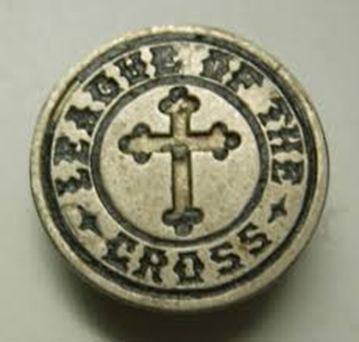
John Glass had been born on the Broomielaw in March 1851 during the famine years, just a short walk from where his Donegal parents James and Ann had disembarked. He was the oldest of five children and the family moved initially to the Gorbals before settling in Bridgeton, where James set up a wood and glazing business which his two sons would take over in due course. Married in St Mary’s Church in 1868, John Glass threw himself into parish life. He was a “foremost worker” in the Catholic Union as well as President and Secretary of St Mary’s branch of the League of the Cross. He played a central role in improving the welfare of his East End community, despite personal tragedy: aged only 32, his wife Agnes died in childbirth in 1883 (the death certificate signed by local surgeon, Dr. John Conway).
John Glass was also a founder member and President of Branch O’Connell (Calton) of the Irish National Foresters’ Benefit Society, one of the many friendly societies which sprung up in the pre-Welfare State era to provide financial and social services to members. The INF broke away from the Ancient Order of Foresters in 1877 due to political differences and became the biggest friendly society in Ireland and had 64 branches in Scotland at its height. The Rule Book of the Branch Heart of Erin (Cowcaddens) 1884 outlined the main aim of the society as: “The raising of money by contribution of members; entrance fees and donations” in order to “Pay weekly allowance to members when bodily sick; pay for the decent burial of members and their lawful wives (and) pay for supplying medical attendance and medicines to members.”
Writing in The Irish Voice in 2016, Joe Fodey outlined the community workings of the INF at parish level: “The INF was not merely an insurance organisation to which the member had an external relationship. It was a fraternity. By joining the member – while ensuring his own welfare – was also taking on responsibility for the welfare of other members.” In return for a weekly subscription, if the member ended up out of work due to sickness, the local INF branch would pay the individual an allowance and arrange for medical attention and medicines. Visits to members on the sick list was undertaken by branch officials to maintain contact was considered essential as was “the commitment to attend the funerals of members and their wives and thereby add respectful dignity to the occasion.”
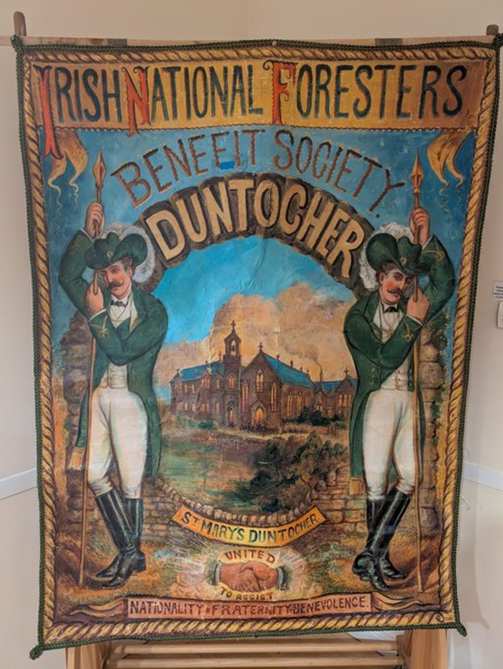
In an address to Branch Parnell of the INF in Bridgeton in April 1888, Dr John Conway highlighted that membership of the Foresters meant more than the material benefits and that branch assistance in helping families make proper provision for ‘the evil day’ helped members of the local community to be independent and maintain self-respect, which hadn’t always been the case for the Irish in Glasgow. Slowly but surely, through these networks of mutuality stretching across health, education, abstinence and social care and organised by lay members under the umbrella of the Catholic Church, the Glasgow Irish began to lift themselves out of poverty, disease and hopelessness.
As if that weren’t enough, the second-generation Irish in Glasgow also found time to make an impact politically but the focus of their activities was the Irish national question rather than local issues. In the 1870s the Glasgow Home Rule Association, led by Ulster Protestant John Ferguson, was the main Irish political vehicle in the city. Ferguson was a tireless campaigner for Irish independence and a powerful public speaker and it was principally through his efforts that St. Patrick’s Day became a major celebration in Glasgow at the time, despite opposition to his politicisation of the event from Catholic clergy. Ferguson was to become a key political ally of Michael Davitt, the former Fenian who led the successful Irish Land League, and when Davitt took a leading role in the new Irish National League (INL), set up to organise extra-parliamentary support for Irish Home Rule in both Ireland and the UK, Ferguson set up the Home Government Branch (HGB) in Glasgow, one of the largest and most influential outside of Ireland which Davitt later referred to as ‘the boss branch.’

The HGB, in which John Glass was regarded as “a silent worker” in the role of Treasurer for many years, became a training ground for radicals led by Ferguson, some of whom would go on to play an influential role in the foundation of the Scottish Labour Party. It was the HGB which organised Michael Davitt’s successful speaking tours of Scotland and became increasingly proactive in promoting Irish and radical candidates in municipal and other elections. One active HGB member in the mid-1880s was William McKillop who had set up a successful licensed grocery business with his brother John and they would go on to own some of Glasgow’s major restaurants. Born in Dalry, Ayrshire in 1858 to Daniel and Matilda McKillop who came originally from Glenarm, County Antrim, William and his brother moved to the Gorbals initially and then crossed the river to become parishioners of St. Alphonsus Church on London Road.
Through the 1880s, William McKillop developed political acumen as well as important connections through the HGB. This, along with wealth accumulated from the family business, allowed him to successfully stand for election on behalf of the Irish Party in Westminster following Davitt’s lead and went on to become MP for North Sligo in 1900 and then South Armagh in 1906. The son of Irish parents who left their country for Scotland during An Gorta Mór was now representing an Irish constituency in Parliament in support of the cause of Irish Home Rule. This was a further indication of how the Irish in Glasgow had not only stabilised as a community but were now developing confidence and progressing.
CREATED BY IMMIGRANTS
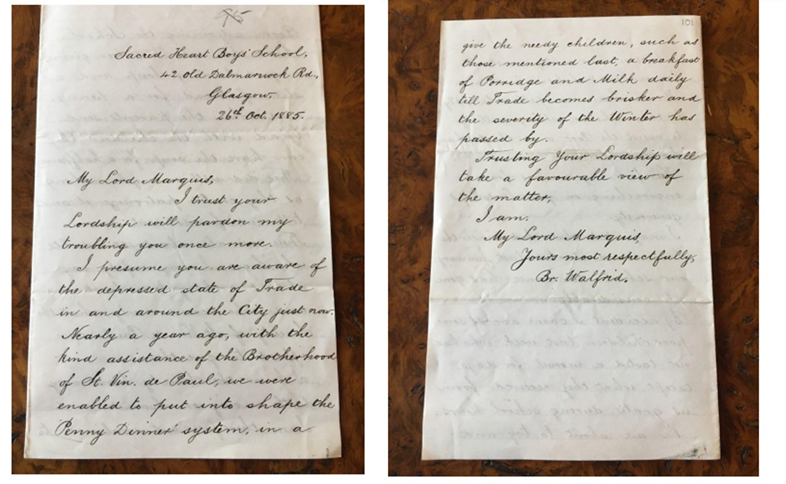
By 1885, three decades on from Alexander Brown’s forays into the large Irish community settled around Glasgow Cross, there had been much improvement in the condition of the Glasgow Irish but significant challenges remained. Poverty and hunger still affected many in the community, especially in times of economic depression. In October 1885 the headmaster of Sacred Heart Boys’ School in Bridgeton, Brother Walfrid, wrote in a letter that “By accident, I came across some poor children last week who had not tasted a morsel for days, except what they received from us gratis during school hours.”
The letter was sent to the 3rd Marquis of Bute, John Patrick Crichton-Stuart. When he inherited his father’s estate at the age of just six months, it was believed this made him the richest person in the world at that time. His high-profile conversion to Catholicism in 1868 caused a public scandal in Victorian Britian. He became one of the greatest benefactors of the Catholic Church in Scotland and this was why Brother Walfrid was writing to him: to seek his financial support for a project which the head teacher had begun almost a year earlier with the help of the Bridgeton conference of the SSVP. Referring to the project as the ‘penny dinner system’ Brother Walfrid outlined what was now being provided from a kitchen adjoining the school:
We have been giving a good bowl of Soup and a slice of Bread for a penny, and when the parents send bread with the children they can have the soup for a halfpenny. This did well enough as long as they could patronize it and till our funds went down.
There are also about 150 adults, who have, I may safely say, almost nothing to subsist on, and who receive daily, what the Society of St. Vin de Paul can afford to give them. I know the Society have very little money on hand, and I am therefore not inclined to ask their ever ready assistance, for our poor children just now. Hence I am compelled to apply, to those who are always willing to assist the Poor and the Orphan, for some help.
I may state that since the ‘Dinners’ were started, last January, our school attendance has gone up considerably . . . We are about to try and give the needy children, such as those mentioned last, a breakfast of Porridge and Milk daily till Trade becomes brisker and the severity of the Winter has passed by.
This handwritten letter was discovered by Michael Connolly whilst researching for a PHD into the life of Brother Walfrid. In his subsequent book Walfrid – A Life of Faith, Community and Football, Connolly identified the letter as illustrating the twin intentions of the Poor Children’s Dinner Table scheme started by Walfrid at Sacred Heart School then rolled out to other Marist schools in the East End of Glasgow: “providing physical sustenance to local Irish Catholic children, as well as enabling them to receive education in the tradition of their own faith.”
The Dinner Tables were an immediate success. By 1886 the number of pupils attending Sacred Heart School had quadrupled from its foundation twelve years earlier to over 1,200 pupils. At St Mary’s in the Calton in the first six months of 1886 26,421 dinners had been provided, 17,707 which were free. The success in encouraging more children out of work and into school created a dilemma, as outlined by Celtic historian Brendan Sweeney: “The problem was clear: demand far exceeded the income available as almost 70% could not afford to pay anything and less than 4% were able to pay the full penny. More had to be done and quickly.” Providing almost two thousand dinners a week was a huge financial challenge for the Marists and the SSVP which helps explain letters to leading Catholic philanthropists seeking their support. Fresh sources of funding were desperately required. The enterprising Brother Walfrid hit on a new idea to keep the Dinner Tables going: the massively popular sport of football.
The Marist organised a series of charity football games in Bridgeton in 1886 and 1887 involving leading sides such as Renton, Hibernian, Clyde and Harp (from Dundee). These culminated in the East End Charity Cup game between the latter two teams in May 1887 which was watched by over 12,000 people – only 3,000 less than had seen Hibs win the Scottish Cup a few months earlier at Hampden. The huge sum of monies raised from these games kept the Dinner Tables stocked for at least a year. Raising funds through football had proven a Marist masterstroke.
Over the course of the summer of 1887 discussions took place about the possibility of starting a Catholic football team based in Glasgow’s East End whose primary purpose would be to sustain the Poor Children’s Dinner Tables in the three parishes in Calton, Bridgeton and Parkhead. These talks culminated in a meeting held in the League of the Cross Hall behind St. Mary’s Church on 6th November 1887 when Celtic Football Club was established.
That meeting elected a committee to run the new club and, in January 1888, the Committee issued a fundraising circular seeking financial support from parishioners:
The main objective of the club is to supply the East End conferences of the St. Vincent De Paul Society with funds for the maintenance of the “Dinner Tables” of our needy children in the Missions of St Mary’s, Sacred Heart, and St. Michael’s. Many cases of sheer poverty are left unaided through lack of means. It is therefore with this principal object that we have set afloat the “Celtic”, and we invite you as one of our ever-ready friends to assist in putting our new Park in proper working order for the coming football season.
The Committee was made up of the following individuals:
Honorary President – Dr. John Conway
President – John Glass
Treasurer – Hugh Darroch
Secretary – John O’Hara
Match Secretary – William Maley
J.M. Nelis
Joseph Shaughnessy
M. Cairns
J.H. McLaughlin
W. McKillop
T.E. Maley
Daniel Malloy
John McDonald
Joseph McGroary
David Meikleham
Patrick Welsh
Although he was at no point an office-bearer or a formal Committee member, Brendan Sweeney’s research has established that Brother Walfrid, the key figure in the founding of the club, was a regular attender at Committee Meetings and all General Meetings of the new club through until his departure from Glasgow in 1892.
Of those 17 men, five were Irish-born (Walfrid, O’Hara, Maley, McDonald and Welsh), eleven were second-generation children of Irish parents all born in Scotland (with the exception of Tom Maley, who was born in Portsmouth) and one had no Irish ancestry (David Meikleham). All were practising Catholics.
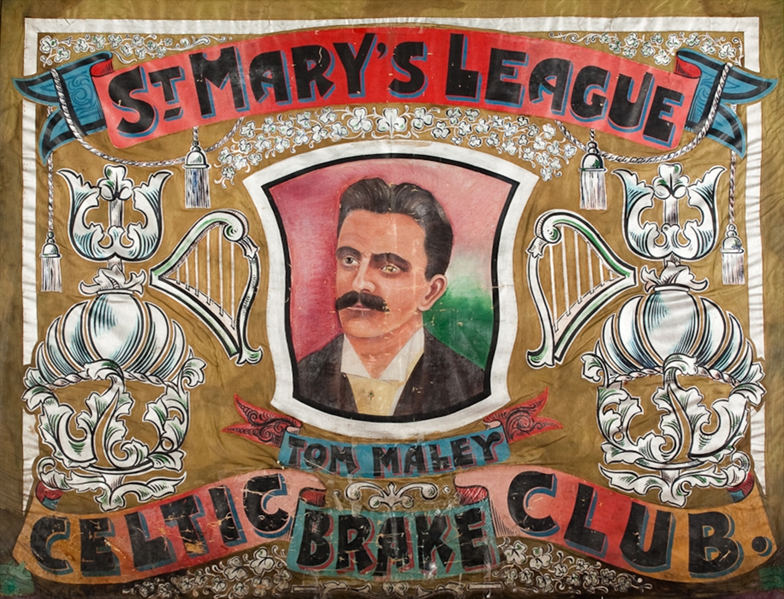
Without exception, each of them had played a part in those ‘networks of mutuality’ that had helped stabilise and gradually lift the Glasgow Irish out of the hellish circumstances that prevailed in the 1840s and 1850s. They were immigrants, refugees or their children. They faced many of the obstacles and hardships that immigrants and refugees coming to Scotland and Britain face today – as well as outright hostility due to their race, religion and ethnicity. The racist stereotypes are largely unchanged over 150 years on: lazy, workshy, not wanting to assimilate, swamping our society and diluting our identity. The same lies and cliches that were trotted out against the Irish then are now thrown at those with darker skins looking for a better life for themselves and their families.
Celtic Football Club is now the largest and most successful club in football-mad Scotland. It is the best-known symbol of the Irish diaspora in the sporting world. The community of Glasgow Irish from which the club sprang highlights the importance of integration rather than assimilation and the need for immigrant communities to be able to maintain their identities in order to survive and thrive – for the benefit of society as a whole.
Celtic Football Club is an immigration success story.
Glasgow Cross – ‘The headquarters of Popery in this City’
Read part one of Thousands Are Sailing here: https://the-shamrock.net/thousands-are-sailing/

Read more Celtic history articles from The Shamrock here: https://the-shamrock.net/the-shamrock-online/

Issues 1-10 of The Shamrock fanzine can be bought here: https://the-shamrock.net/magazine/

 the shamrock